The Pharmacy Sales Process in Canada: A Complete Timeline from Listing to Closing
Selling your pharmacy is not like listing a house. You cannot put a sign in the window, wait for offers, and close in 30 days.
The pharmacy sales process in Canada is a multi-stage journey involving confidential marketing, buyer qualification, complex due diligence, regulatory approvals, and careful coordination among lawyers, accountants, landlords, and provincial pharmacy colleges. The entire process typically takes six to twelve months from initial preparation to final closing.
Most pharmacy owners entering this process for the first time feel overwhelmed by the complexity. What documents do buyers need? How do you maintain confidentiality while marketing your business? What happens during due diligence? Why does closing take so long?
Understanding the process before you start helps you prepare properly, avoid common pitfalls, and maintain momentum through the inevitable challenges that arise. This guide walks you through every stage of selling a pharmacy in Canada, with realistic timelines and practical advice for independent owners in British Columbia, Alberta, Ontario, and across Canada.
Quick Summary: What You Will Learn
- The seven stages of the pharmacy sales process and realistic timelines for each
- How to prepare your pharmacy for sale without alerting staff or competitors
- The role of confidentiality agreements, CIMs, and LOIs in the process
- What happens during buyer due diligence and how to prepare
- Provincial regulatory approval requirements that affect your timeline
- Common deal killers and how to avoid them

The Seven Stages of Selling Your Pharmacy
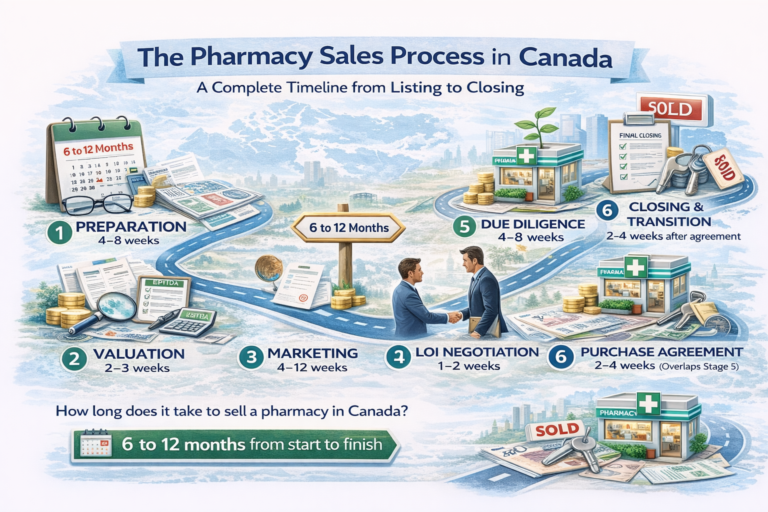
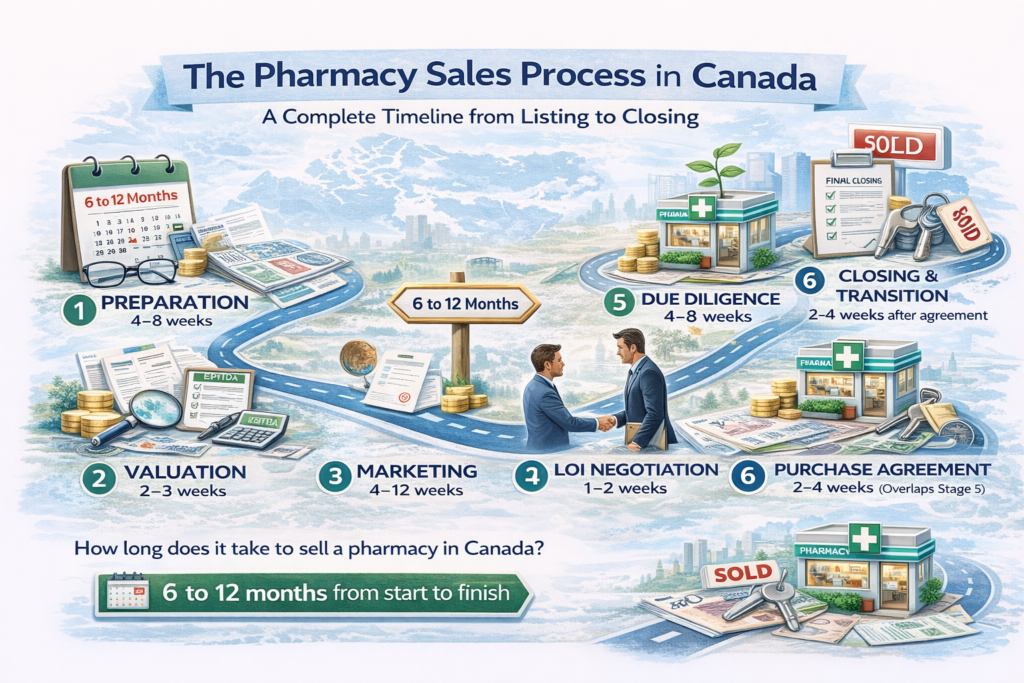
The pharmacy sales process follows a predictable sequence, though timelines vary based on market conditions, your pharmacy’s complexity, and buyer readiness.
Stage 1: Preparation (4-8 weeks) Stage 2: Valuation (2-3 weeks) Stage 3: Marketing (4-12 weeks) Stage 4: Letter of Intent Negotiation (1-2 weeks) Stage 5: Due Diligence (4-8 weeks) Stage 6: Definitive Agreement (2-4 weeks, overlaps with Stage 5) Stage 7: Closing and Transition (2-4 weeks after agreement)
Total timeline: 6 to 12 months from deciding to sell until closing day.
Some transactions close faster (4-5 months if you have a ready buyer with financing). Others take longer (18+ months if market conditions are difficult or your pharmacy has unique challenges). Planning for 9 months is realistic for most independent pharmacy sales.
Stage 1: Preparation (4-8 Weeks)
Preparation determines whether your sale goes smoothly or stalls repeatedly during due diligence.
What Preparation Involves
Financial records organization: Gather three complete years of financial statements (profit and loss, balance sheet, general ledger), corporate tax returns, GST/HST filings, and sales records. Your accountant should prepare these in consistent format.
Prescription volume documentation: Compile monthly prescription counts for the past 36 months, broken down by new prescriptions and refills, payer type (provincial plans, private insurance, cash), and if possible, therapeutic categories.
Lease review: Locate your commercial lease agreement. Confirm remaining term, renewal options, rent amount and escalation clauses, assignability provisions, and landlord contact information. If your lease has less than 3 years remaining with no renewal options, address this immediately with your landlord.
Regulatory compliance verification: Review your pharmacy license status, inspection reports from your provincial college for the past 3 years, narcotics and controlled substances logs, PHIPA/PIPA compliance documentation (privacy policies, breach protocols), and any outstanding compliance issues. Resolve problems before listing.
Corporate records: Ensure your minute book is current with all share certificates, director/officer resolutions, annual filings with provincial corporate registry, and shareholder agreements if applicable.
Employee documentation: Prepare an anonymous list of employees (no names yet for confidentiality) showing positions, tenure, salary ranges, and whether they are full-time or part-time.
Inventory management: Conduct a preliminary inventory count to estimate value. Remove obviously expired products and address any narcotics discrepancies now rather than during due diligence.
Facility assessment: Walk through your pharmacy objectively. Note any deferred maintenance, outdated fixtures, or equipment needing replacement. Decide whether to address these issues before sale or price accordingly.
Maintaining Confidentiality
Critical rule: Do not tell employees, suppliers, or customers you are selling until you have a firm deal.
Premature disclosure creates chaos. Staff worry about job security and may start looking elsewhere. Customers wonder if service will decline and consider switching pharmacies. Suppliers question credit terms. Competitors learn you are vulnerable and may poach patients.
Work with a pharmacy broker who will market your business confidentially using blind profiles that describe the pharmacy without identifying it. When you must leave for meetings, use generic excuses like medical appointments or continuing education.
Choosing to Use a Broker
Most pharmacy sales in Canada involve brokers or business advisors who specialize in healthcare transactions.
Broker responsibilities:
- Professional valuation to establish realistic asking price
- Preparation of Confidential Information Memorandum (CIM)
- Confidential marketing to qualified buyer database
- Screening buyers for financial capability and seriousness
- Coordinating viewings and information requests
- Negotiating letters of intent and purchase terms
- Managing due diligence process and timeline
- Facilitating communication between parties and advisors
Broker fees: Typically 5% to 10% of sale price for smaller pharmacies, often with minimum fees of $25,000 to $50,000. The fee is success-based, paid only at closing. Some brokers charge small upfront retainers ($5,000 to $10,000) that credit against the final fee.
While you can sell without a broker to save fees, most owners find the expertise, buyer network, and negotiation support worth the cost. Brokers often obtain higher prices that exceed their fees.
Stage 2: Valuation (2-3 Weeks)
Before marketing, you need a defensible valuation based on market data and your pharmacy’s financial performance.
Your broker or business valuator will:
- Calculate normalized EBITDA with appropriate add-backs
- Apply market multiples (typically 4x to 6x EBITDA for Canadian community pharmacies)
- Assess qualitative factors (location, competition, lease, growth potential)
- Research comparable pharmacy sales in your province
- Provide a valuation range (e.g., $1.2M to $1.5M)
Set your asking price at the top of the range if market conditions are strong and your pharmacy has clear advantages. Price conservatively if you need to sell quickly or have weaknesses (short lease, declining scripts, pending nearby competition).
Realistic pricing matters. Overpriced pharmacies sit on the market for months, become “stale listings,” and eventually sell for less than they would have with proper initial pricing. Underpricing leaves money on the table. Professional valuation helps you price competitively.
Stage 3: Marketing (4-12 Weeks)
Marketing a pharmacy for sale requires balancing visibility to attract buyers with confidentiality to protect your business.
Preparing the Confidential Information Memorandum (CIM)
The CIM is a comprehensive document (15-30 pages) that presents your pharmacy professionally to qualified buyers. Your broker typically prepares this.
Standard CIM contents:
- Executive summary with key highlights
- Business overview (history, location, services, hours)
- Market analysis (demographics, competition, growth trends)
- Financial performance (3 years historical, normalized EBITDA analysis)
- Prescription volume trends and payer mix breakdown
- Facility description and photos
- Staff overview (anonymous for confidentiality)
- Lease terms and rent details
- Equipment and technology list
- Growth opportunities identified
- Transaction structure (asset vs share sale preference)
- Asking price and terms
The CIM presents your pharmacy in the best light while remaining factual. Exaggerations that collapse during due diligence destroy deals.
Buyer Qualification Process
Not everyone who expresses interest is a legitimate buyer.
Before sharing your CIM, brokers qualify buyers by:
- Confirming pharmacist licensure (most buyers must be licensed pharmacists in Canada, depending on provincial rules)
- Verifying financial capacity (proof of funds, bank pre-qualification letter)
- Assessing seriousness (why are they buying? what is their timeline?)
- Checking references from past transactions if they are experienced buyers
Only qualified buyers receive the CIM after signing a Non-Disclosure Agreement (NDA).
Non-Disclosure Agreements (NDAs)
Every potential buyer must sign an NDA before receiving identifying information about your pharmacy.
Standard NDA provisions:
- Confidential information defined broadly (financials, patient data, operations, employees)
- Restriction on use (only for evaluating the potential purchase)
- Prohibition on disclosure to third parties without permission
- Return or destruction of information if buyer does not proceed
- Non-solicitation clause (buyer cannot hire your staff or contact your customers during the process)
- Duration (typically 2-5 years)
NDAs are legally binding. They provide some protection but cannot eliminate all confidentiality risk. Vet buyers carefully before sharing sensitive information.
Managing Buyer Viewings
Qualified buyers eventually want to see the pharmacy in person. This is where confidentiality becomes challenging.
Best practices for viewings:
- Schedule viewings during slower times or after hours when possible
- Brief buyers beforehand to avoid obvious questions in front of staff
- Introduce the buyer as a colleague, consultant, or potential associate if asked
- Limit time in the dispensary during busy periods
- Conduct detailed operational discussions off-site (at lawyer’s office or restaurant)
- Never allow buyers to interact with patients
Most viewings last 30-60 minutes for initial assessment, with follow-up visits only after serious interest develops.
Stage 4: Letter of Intent Negotiation (1-2 Weeks)
When a buyer is seriously interested, they submit a Letter of Intent (LOI).
What an LOI Includes
An LOI is a preliminary, mostly non-binding document outlining major deal terms.
Typical LOI contents:
- Proposed purchase price (may be a range, subject to final inventory count)
- Transaction structure (asset sale or share sale)
- Assets included and excluded
- Deposit amount and timing
- Financing contingency (if buyer needs bank approval)
- Due diligence period length (usually 30-60 days)
- Exclusivity period (buyer gets exclusive negotiation rights for 60-90 days)
- Major closing conditions (lease assignment, regulatory approvals, financing)
- Target closing date
- Allocation of transaction costs (who pays legal fees, adjustments)
Binding vs non-binding provisions:
Most of the LOI is non-binding, meaning either party can walk away during due diligence or negotiation. However, certain clauses are typically binding:
- Confidentiality obligations
- Exclusivity (you cannot negotiate with other buyers during the exclusivity period)
- Good faith negotiation requirements
- Expense responsibility if deal terminates for specific reasons
LOI Negotiation Points
Expect back-and-forth on several terms:
Price: Initial offers often come in 10-15% below asking price. Negotiate based on your valuation support and market conditions.
Deposit: Buyers typically offer 5-10% of purchase price as deposit. Higher deposits signal stronger commitment.
Exclusivity period: Buyers want long exclusivity (90-120 days) to complete due diligence without competition. Sellers prefer shorter periods (30-60 days) to maintain pressure. Compromise around 60-75 days with extension provisions if buyer is proceeding in good faith.
Due diligence scope: Buyers request access to all business records. Sellers can reasonably limit invasive requests until later stages. Define what documents will be provided immediately vs. upon request.
Financing contingency: If the buyer needs bank approval, the deal is conditional on financing. Confirm the buyer has already spoken with their bank and has preliminary approval. Set a deadline for final financing commitment (usually 30-45 days).
Accepting an LOI
Once you accept an LOI, the exclusivity period begins. You cannot negotiate with other buyers, so choose carefully.
If you receive multiple LOIs simultaneously, leverage them to improve terms. But avoid auction dynamics that create animosity. Select the buyer most likely to close successfully (strong financing, reasonable conditions, relevant experience) rather than simply the highest price.
Stage 5: Due Diligence (4-8 Weeks)
Due diligence is the buyer’s process of verifying everything you represented about the business.
Expect intense scrutiny of your pharmacy’s financial, operational, legal, and regulatory condition.
Financial Due Diligence
Buyers and their accountants will examine:
- Three years of complete financial statements and tax returns
- General ledger detail for major expense categories
- Bank statements showing revenue deposits
- Accounts receivable aging (if any receivables transfer)
- Accounts payable listing
- Loan agreements and debt schedules
- Related party transactions (if you own the building or have other businesses)
They are verifying:
- Revenue matches your representations (no undisclosed declines)
- Expenses are categorized correctly
- EBITDA normalization adjustments you claimed are legitimate
- No hidden liabilities or off-balance-sheet obligations
Your response: Provide organized, complete records promptly. Delays create suspicion. Have your accountant available to answer questions.
Operational Due Diligence
Buyers want to understand day-to-day operations and verify prescription volume.
Common requests:
- Monthly prescription reports from pharmacy software for 36 months
- Breakdown by payer (government plans, private insurers, cash)
- Third-party billing statements and remittance summaries
- Inventory reports showing turnover rates
- Supplier invoices (sample months)
- Professional services billing records (if applicable in your province)
- Staff schedules and payroll summaries
- Delivery logs (if you provide delivery services)
They are verifying:
- Prescription counts match your CIM representations
- Revenue sources are stable and diversified
- Gross margins align with industry norms
- No unusual patterns (like suspicious billing spikes)
Your response: Pull reports from your pharmacy management system. Redact patient names to maintain privacy. Provide summaries and trend analysis to help buyers interpret the data.
Legal and Regulatory Due Diligence
This is where many pharmacy deals encounter problems.
Buyer’s counsel will request:
- Pharmacy license and current status with provincial college
- All inspection reports for the past 3-5 years
- Any college complaints or discipline history
- Narcotics and controlled substances reconciliation logs
- Privacy policies and PHIPA/PIPA compliance documentation
- Any privacy breach reports filed with regulators
- Employment agreements and contractor arrangements
- Commercial lease with all amendments
- Supplier contracts and terms
- Franchise or banner agreements (if applicable)
- Insurance policies (liability, property, professional)
- Litigation history and threatened claims
They are verifying:
- No regulatory issues that could affect future operations
- Lease is assignable and has sufficient term remaining
- No hidden compliance problems
- Employment relationships are clear
Your response: Be completely transparent. If you had a college inspection with minor deficiencies that were corrected, disclose this with evidence of correction. Hiding issues that surface later kills deals and may expose you to legal claims for misrepresentation.
Lease Assignment Approval
If the transaction is an asset sale, the buyer must obtain landlord consent to assign the lease or sign a new lease.
Process:
- Notify landlord of pending sale (often required in lease agreement)
- Provide buyer’s financial information to landlord for approval
- Negotiate any lease modifications or rent adjustments
- Obtain landlord’s formal consent letter
Timeline: Allow 2-4 weeks for landlord review and approval.
Risk: Landlords sometimes refuse assignment or demand unreasonable rent increases. This can kill deals. Address this early by reviewing your lease carefully and speaking with your landlord informally before listing.
Regulatory Approvals
Provincial colleges of pharmacy must approve ownership changes.
Typical requirements:
- Application for new pharmacy license (if asset sale) or ownership change notification (if share sale)
- Criminal record checks for new owner
- Proof of pharmacist licensure for owner/manager
- Proof of professional liability insurance
- Compliance with ownership rules (in some provinces, pharmacists must own pharmacies or hold controlling interest)
Timeline: Allow 4-8 weeks for provincial college processing. Start applications immediately after LOI acceptance.
In British Columbia: College of Pharmacists of British Columbia must approve pharmacy ownership transfers. Processing time typically 4-6 weeks.
In Alberta: Alberta College of Pharmacy handles licensing. Similar timelines.
In Ontario: Ontario College of Pharmacists requires notification and approval. Can take 6-8 weeks if issues arise.
Delays in regulatory approval delay closing. Submit applications early and ensure all documentation is complete.
Stage 6: Definitive Purchase Agreement (2-4 Weeks, Overlaps with Due Diligence)
While due diligence proceeds, lawyers draft the Definitive Purchase Agreement (also called the Asset Purchase Agreement or Share Purchase Agreement depending on structure).
What the Definitive Agreement Includes
This is the legally binding contract that replaces the non-binding LOI.
Standard sections:
- Purchase price and payment terms (cash at closing, holdbacks, earn-outs if applicable)
- Assets purchased and liabilities assumed (or explicitly not assumed)
- Inventory valuation method and closing count procedures
- Working capital adjustments
- Representations and warranties by seller (business condition, compliance, financial accuracy)
- Representations and warranties by buyer (ability to close, financing)
- Conditions precedent to closing (financing, approvals, due diligence satisfaction)
- Indemnification provisions (who pays if representations are breached)
- Survival periods (how long representations remain enforceable)
- Non-competition and non-solicitation clauses
- Transition assistance obligations
- Allocation of purchase price for tax purposes
- Closing date and mechanics
Length: Typically 30-60 pages with schedules and exhibits.
Key Negotiation Points
Representations and warranties: Buyers want extensive promises about business condition. Sellers want to limit exposure. Negotiate:
- Knowledge qualifiers (“to seller’s knowledge” limits liability for unknown issues)
- Materiality thresholds (minor breaches do not trigger indemnity)
- Survival periods (how long can buyer make claims? 12-24 months is common)
- Caps on indemnity (maximum total liability)
- Baskets (minimum claim amount before indemnity applies)
Holdbacks: Buyers often withhold 5-15% of purchase price in escrow for 6-12 months to cover any breaches of representations or post-closing adjustments.
Inventory: Agree on valuation method (typically at cost per supplier invoices), exclusions (expired or damaged items), and count timing (usually within 24-48 hours of closing).
Non-compete: Buyers require sellers to agree not to open or work in competing pharmacies within a defined radius (often 5-10 km) for a defined period (typically 3-5 years). Negotiate geographic scope and duration to be reasonable.
Transition assistance: Buyers usually require sellers to remain available for 2-8 weeks after closing to introduce the new owner, explain workflows, and support the transition. Negotiate compensation and time commitment.
Legal Costs
Each party pays their own legal fees unless otherwise negotiated. Expect legal costs of:
- Seller: $10,000 to $25,000 depending on complexity
- Buyer: $15,000 to $35,000 (higher due to more extensive due diligence)
Budget accordingly and engage experienced pharmacy transaction lawyers, not general practice lawyers.
Stage 7: Closing and Transition (2-4 Weeks After Agreement)
Once the Definitive Agreement is signed and all conditions are satisfied, you schedule closing.
Pre-Closing Activities
Final inventory count: Conducted jointly (seller, buyer, and often a neutral third party) 24-48 hours before closing. Count all prescription inventory, front-shop merchandise, and narcotics separately. Calculate value based on agreed methodology.
Adjustment calculations: Lawyers prepare a closing statement showing:
- Base purchase price
- Plus/minus inventory adjustment (if different from estimated amount)
- Plus/minus working capital adjustments
- Minus holdback amount (if any)
- Transaction costs allocation
Document preparation: Lawyers finalize all closing documents:
- Bill of sale (asset sale) or share transfer forms (share sale)
- Assignment and assumption agreements (lease, contracts)
- Promissory notes (if vendor financing)
- Escrow agreement (if holdback)
- Employment agreements (if seller staying on)
- Regulatory filings and notifications
Closing Day
Closing typically occurs at the buyer’s lawyer’s office or electronically.
Closing sequence:
- Final document review and signing by both parties
- Buyer’s lawyer confirms financing funds are available
- Seller’s lawyer releases pharmacy license and access
- Buyer’s lawyer transfers funds to seller’s lawyer (via wire transfer or certified cheque)
- Both lawyers register required documents (corporate registry filings, lease assignments)
- Keys and access codes transferred to buyer
- Seller’s lawyer releases funds to seller (minus any holdbacks and legal fees)
Timeline: The actual closing meeting takes 1-3 hours if everything is in order.
Post-Closing Transition
Most agreements require the seller to assist the buyer for a defined transition period.
Typical transition activities:
- Introduce new owner to staff (often the first time staff learn of the sale)
- Walk through daily operations and workflows
- Introduce new owner to key suppliers and clinic physicians
- Transfer phone numbers, website, email access
- Provide pharmacy software training and access
- Explain special patient needs or relationships
- Support third-party billing setup and testing
Duration: Usually 1-4 weeks, often with the seller working part-time or on-call rather than full daily presence.
Compensation: Sometimes included in purchase price, sometimes paid separately ($500-$1,500 per day is common).
Announcing the Sale
Once closing occurs, announce the sale professionally:
- Staff meeting first (before they hear through rumors)
- Patient communication (letter, email, in-store signage)
- Supplier and clinic notifications
- Social media and website updates
- Local pharmacy college notification (if not already done)
Frame the announcement positively, emphasizing continuity of care and introducing the new owner’s qualifications and commitment to the community.

Common Deal Killers and How to Avoid Them
Many pharmacy sales fail despite both parties wanting to close. Here are the most common reasons and prevention strategies.
Deal Killer 1: Undisclosed Problems Surface During Due Diligence
What happens: Buyer discovers financial irregularities, regulatory violations, or misrepresented prescription volumes during due diligence. Trust evaporates and the buyer walks away or demands significant price reduction.
Prevention: Disclose everything upfront. If you had a college inspection with deficiencies, mention it in the CIM with proof of correction. If prescription counts declined 5% last year, explain why and what you have done to address it. Transparency builds trust.
Deal Killer 2: Buyer Cannot Secure Financing
What happens: Buyer’s bank rejects the loan or approves a lower amount than needed. Deal collapses because buyer cannot fund the purchase.
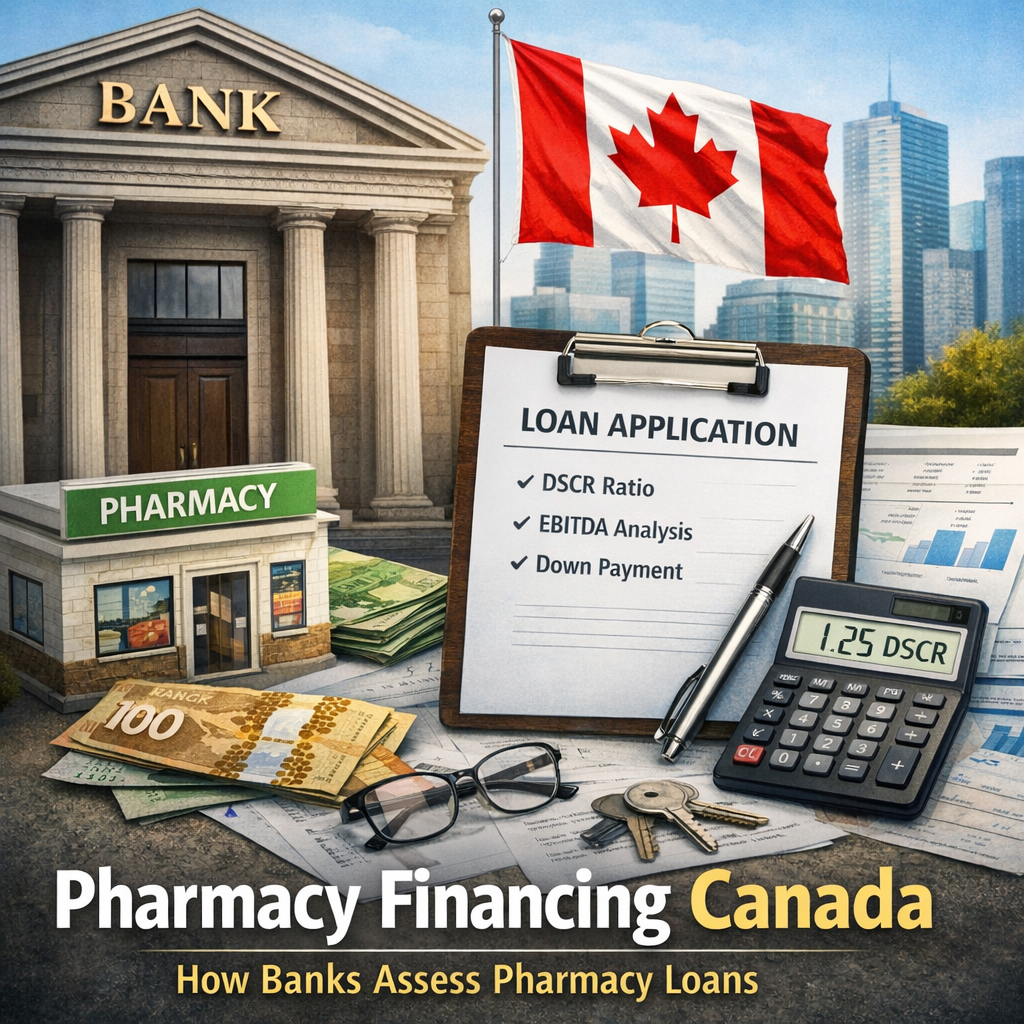
Prevention: Qualify buyers financially before accepting their LOI. Require proof of bank pre-approval or proof of funds (if cash buyer). Include financing deadlines in the LOI so you know quickly if the buyer’s financing will work.
Deal Killer 3: Landlord Refuses Lease Assignment or Demands Major Changes
What happens: Landlord will not consent to lease assignment or demands rent increase or lease term changes the buyer cannot accept.
Prevention: Review your lease carefully before listing. If assignment provisions are unclear or restrictive, speak informally with your landlord before marketing. Consider whether the buyer might negotiate a new lease directly if assignment proves difficult.
Deal Killer 4: Regulatory Approval Delays or Denials
What happens: Provincial college delays processing the ownership change application or raises compliance concerns that delay closing indefinitely.
Prevention: Resolve all outstanding compliance issues before listing. Submit applications immediately after LOI acceptance. Follow up weekly with the college to maintain momentum.
Deal Killer 5: Unrealistic Seller Expectations That Never Adjust
What happens: Seller prices pharmacy based on emotion (“I need $2M to retire”) rather than market data. No qualified buyers emerge at that price. Seller refuses to adjust and the listing goes stale.
Prevention: Obtain professional valuation before listing. Accept market reality even if it is disappointing. Price competitively to attract multiple buyers, which can create upward pressure on offers.
Deal Killer 6: Loss of Confidentiality Damages the Business
What happens: News of the sale leaks to staff or community prematurely. Key employees leave. Patients switch to competitors. Prescription volume drops during the sale process, reducing value.
Prevention: Maintain strict confidentiality protocols. Only disclose to essential advisors (lawyer, accountant, broker). Do not discuss the sale with staff, suppliers, or friends. Work with a broker who understands confidential marketing.
Deal Killer 7: Transaction Fatigue and Excessive Delays
What happens: Due diligence drags on for months. Parties lose enthusiasm. Other opportunities arise for the buyer. The deal slowly dies from neglect.
Prevention: Set clear timelines in the LOI and hold both parties accountable. Respond promptly to information requests. Keep momentum by scheduling regular update calls. A deal that takes 12+ months has a high failure rate.
Practical Timeline Planning Checklist
12 Months Before Intended Sale:
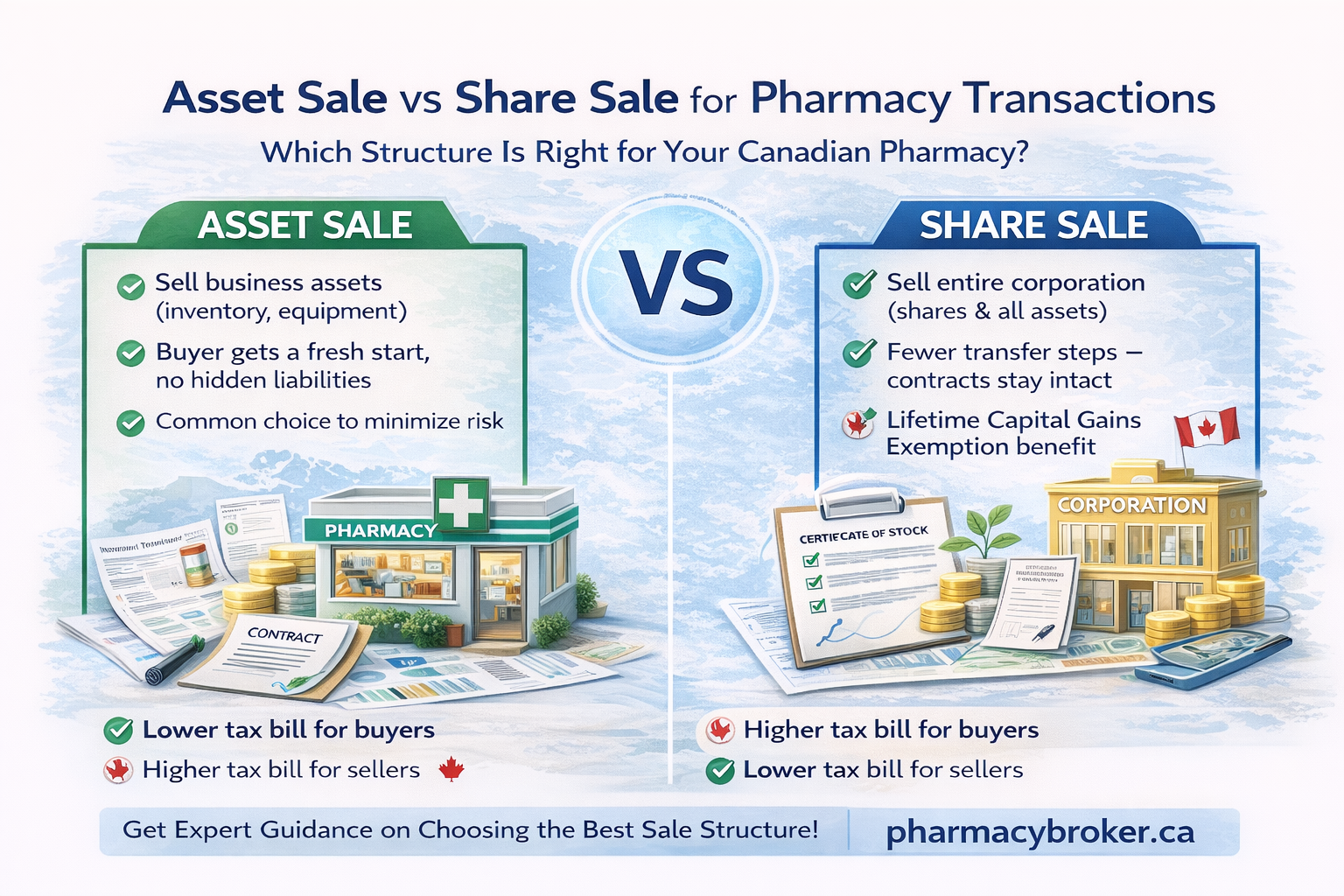
- Consult accountant about asset vs share sale structure and tax planning
- Review and address any regulatory compliance issues
- Consider facility improvements that increase value
- Begin organizing financial records
6-9 Months Before Intended Sale:
- Engage pharmacy broker or business advisor
- Complete professional valuation
- Prepare Confidential Information Memorandum
- Review and potentially renegotiate lease if term is short
- Ensure corporate records are current
Upon Listing:
- Begin confidential marketing to qualified buyers
- Respond to buyer inquiries through broker
- Prepare for viewings
After Receiving LOI (Month 1-2 of Process):
- Negotiate and accept Letter of Intent
- Engage transaction lawyer
- Submit regulatory approval applications
- Begin organizing due diligence materials
During Due Diligence (Month 2-4 of Process):
- Provide requested documents promptly
- Facilitate buyer meetings with landlord
- Support buyer’s bank financing application
- Negotiate Definitive Purchase Agreement
Pre-Closing (Month 4-6 of Process):
- Complete final inventory count
- Prepare closing documents
- Arrange transition schedule
- Plan staff and patient communications
Closing and Transition (Month 6+ of Process):
- Execute closing
- Transfer possession and access
- Support buyer during transition period
- Complete post-closing obligations (holdback release, etc.)
Conclusion: Process Matters as Much as Price
A well-managed sales process protects your pharmacy’s value, maintains confidentiality, and increases the likelihood of successful closing.
Many pharmacy owners focus exclusively on price and neglect the process. They list without proper preparation, maintain inadequate confidentiality, provide disorganized due diligence materials, and alienate buyers through slow responses. These mistakes cost time, money, and sometimes the entire deal.
The pharmacy sales process is complex and time-consuming, but it is also predictable. Knowing what to expect at each stage helps you prepare appropriately, avoid surprises, and navigate challenges that inevitably arise.
Start early. Prepare thoroughly. Work with experienced advisors. Maintain momentum. The effort you invest in managing the process properly pays dividends in a smoother transaction and better outcome.
If you are considering selling your pharmacy and want guidance on the complete process from preparation through closing, our team provides comprehensive pharmacy brokerage services across Canada. Contact us for a confidential consultation about your situation and timeline.
Links to provincial pharmacy regulatory bodies and pharmacy transfer procedures:
Ontario College of Pharmacists
About the Author:

Arash Pourzare, Pharm.D., is a Canadian pharmacist, pharmacy owner, and pharmacy business consultant. Through PharmacyBroker.ca, he helps pharmacists and entrepreneurs value, buy, sell, and grow pharmacy businesses across Canada.