How Canadian Banks Evaluate Pharmacy Financing: What Buyers and Sellers Need to Know
When it comes to pharmacy financing Canada, understanding how banks finance pharmacy acquisitions matters just as much to sellers as it does to buyers.
Sellers need buyers who can actually close. A buyer with inadequate financing wastes months of your time, disrupts your business through due diligence, and ultimately walks away when their bank rejects the loan. Meanwhile, you have lost momentum, leaked confidentiality, and potentially damaged other buyer relationships through your exclusivity period.
Buyers need realistic expectations about what they can afford and what banks require. Overestimating your financing capacity leads to accepted offers you cannot fund. Underestimating it means you miss opportunities or negotiate weak positions.
Canadian banks have specific criteria for pharmacy acquisition loans. They evaluate the business differently than other small businesses because they understand pharmacy economics, regulatory requirements, and typical cash flow patterns. Major banks like RBC, Scotiabank, TD, BMO, and CIBC have dedicated healthcare financing teams. Credit unions like Meridian, Coast Capital, and Servus also actively finance pharmacy purchases, often with more flexibility for local borrowers.
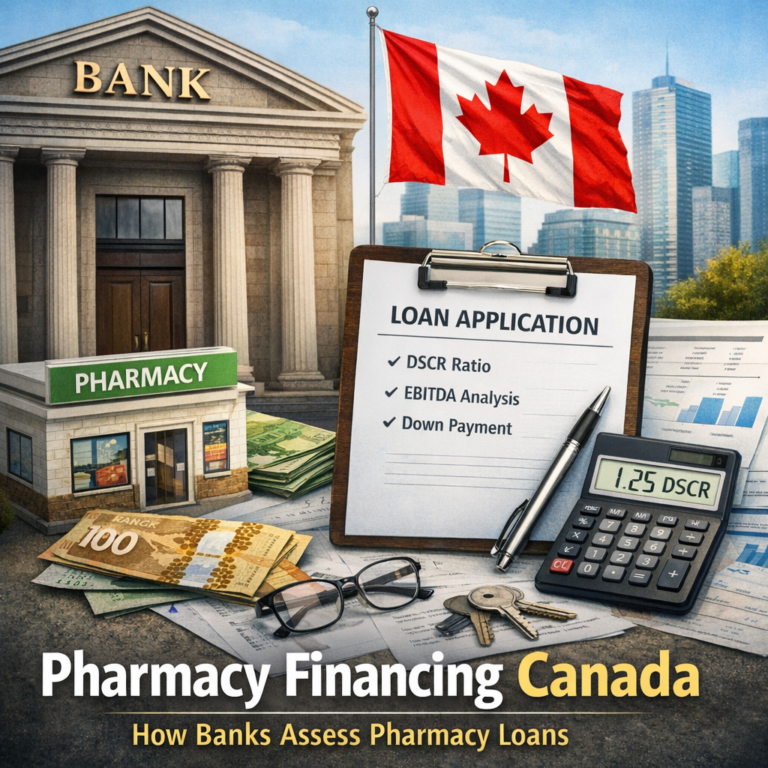
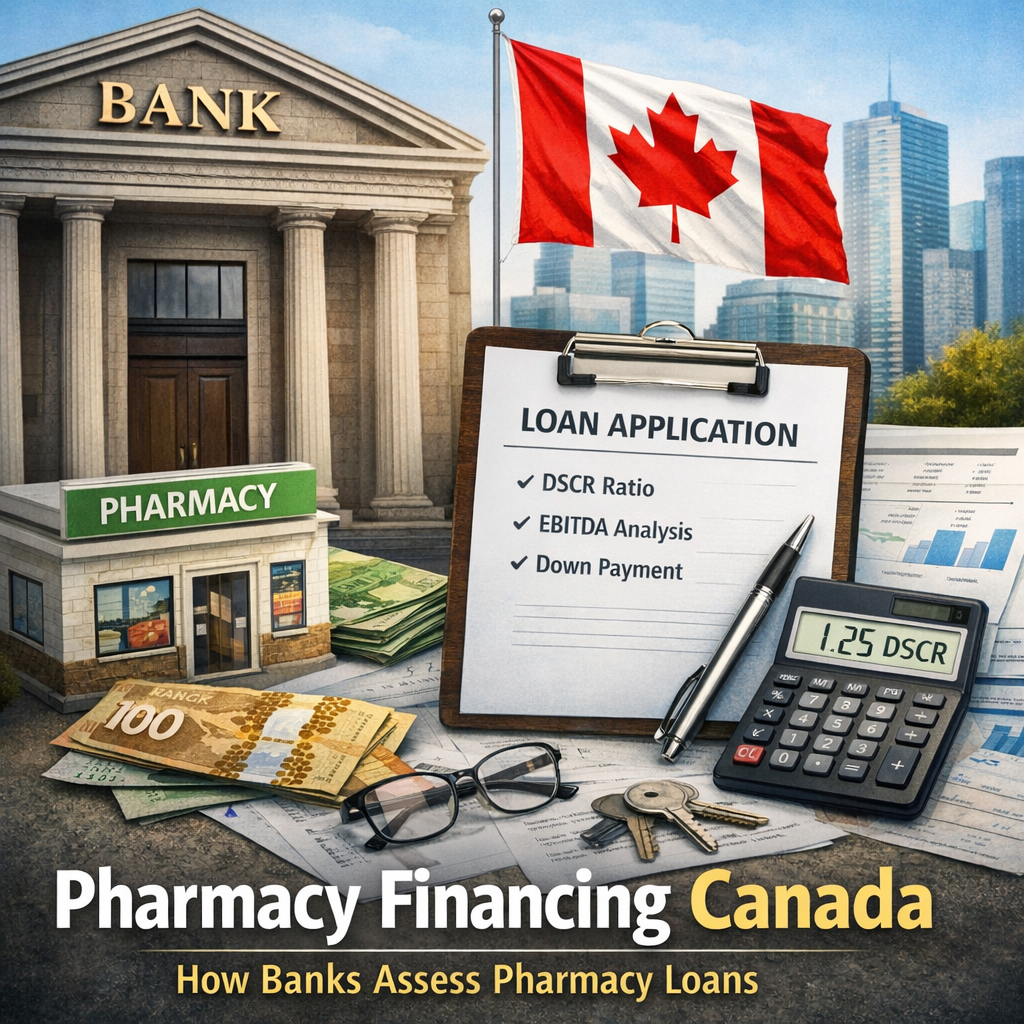
What Canadian Banks Focus on When Financing Pharmacy Purchases – Pharmacy Financing Canada
This guide explains exactly what Canadian banks evaluate when financing pharmacy acquisitions, the metrics that matter most, typical loan structures, and how both buyers and sellers can position themselves for successful financing.
Quick Summary: What You Will Learn
-
- The key financial metrics banks analyze for pharmacy loans
-
- How Debt Service Coverage Ratio (DSCR) determines loan amounts
-
- Typical down payment requirements and loan-to-value ratios
-
- What banks look for in pharmacy financial statements and operations
-
- How lease terms and location affect financing approval
-
- Differences between major banks and credit unions for pharmacy loans
-
- Why normalized EBITDA matters to lenders
Banks approach pharmacy financing with two primary questions: Can this business generate enough cash flow to service the debt? Does the borrower have the capacity and commitment to manage the pharmacy successfully?
Unlike residential mortgages where property value drives lending decisions, pharmacy acquisition loans are primarily cash flow based. Banks care less about hard assets (inventory and equipment depreciate quickly) and more about sustainable earnings that can reliably cover loan payments with a comfortable margin.

Business Viability Assessment
Banks want pharmacies with proven track records of profitability and stable cash flow. They examine:
Historical financial performance: Three years of complete financial statements (profit and loss, balance sheet) and corporate tax returns. Banks look for consistent or growing revenue, stable margins, and positive EBITDA trends.
Prescription volume stability: Monthly prescription counts for 24 to 36 months. Banks want to see stable or increasing script volumes. Declining prescription counts raise immediate red flags about market share loss or demographic changes.
Revenue source diversification: Analysis of payer mix (provincial drug plans, private insurance, cash pay customers). Heavy reliance on a single payer or a few large institutional clients (like one nursing home contract representing 40% of revenue) creates concentration risk that concerns lenders.
Profitability sustainability: Banks assess whether current profitability is sustainable or inflated by temporary factors. For example, if a pharmacy’s EBITDA is heavily dependent on manufacturer rebates in provinces where they remain legal, banks will scrutinize whether those rebate agreements will continue.
Borrower’s Experience and Equity Contribution
The buyer’s qualifications matter enormously.
Professional credentials: Banks prefer buyers who are licensed pharmacists with direct industry experience. First-time pharmacy buyers with pharmacist credentials get better terms than business investors without pharmacy backgrounds.
Management experience: Prior experience managing a pharmacy (even as an associate pharmacist or relief manager) demonstrates operational capability. Banks view buyers who have never managed a pharmacy as higher risk.
Personal financial strength: The borrower’s personal net worth, credit score, and existing debt obligations all factor into approval decisions. A buyer with a strong personal balance sheet (home equity, investments, minimal consumer debt) receives more favorable terms.
Equity contribution: The amount of cash the buyer invests from personal funds signals commitment and affects loan terms. While traditional pharmacy financing typically required 10% to 30% down payment (with 20% being most common), the landscape has evolved. As of 2024-2026, several major Canadian banks now offer up to 100% financing (zero down payment) for highly qualified pharmacist buyers purchasing established pharmacies with strong cash flow. These programs typically require excellent personal credit (720+ score), proven pharmacy management experience, and pharmacies with DSCR of 1.35x or higher. However, higher equity contributions still often result in better interest rates, more favorable terms, and easier approval for buyers who do not meet the strict criteria for zero-down programs. For marginal deals or first-time buyers, 20% to 30% down payment remains standard.
Purpose of Financing and Loan Structure
Canadian banks offer pharmacy financing for various purposes, each with different risk profiles:
Acquisition financing: Purchasing an existing pharmacy (most common). These loans are evaluated based on the target pharmacy’s historical cash flow.
Start-up/new pharmacy financing: Opening a new pharmacy from scratch. These loans are riskier and require stronger borrower credentials, detailed business plans, and often 30-40% equity contribution.
Expansion capital: Adding services, renovating facilities, or acquiring additional locations. Banks view expansion favorably if the existing pharmacy demonstrates strong cash flow.
Refinancing: Replacing existing debt with new financing. Banks evaluate the pharmacy’s current performance and whether refinancing improves debt service capacity.
Equipment and technology: Financing for automation, dispensing systems, or software upgrades. Often structured as separate equipment loans with shorter terms.
How Banks Analyze Pharmacy Financial Statements
Financial statement analysis forms the core of every bank’s underwriting process.
Revenue and Prescription Volume Verification
Banks do not simply accept the seller’s representations. They verify:
Monthly revenue trends: Banks request 24 to 36 months of monthly revenue data to identify seasonality, trends, and anomalies. A pharmacy showing consistent month-over-month revenue growth is far more attractive than one with erratic patterns.
Prescription count documentation: Monthly prescription reports from pharmacy software systems showing new scripts, refills, total script count, and average script value. Banks compare these counts against revenue to verify consistency.
Third-party payer reconciliation: Monthly remittance summaries from provincial drug plans and private insurers. Banks verify that reported revenue matches actual payments received from these sources.
Front-shop vs. prescription revenue: Banks analyze the split between prescription revenue (more stable, predictable) and front-shop retail sales (more variable, discretionary). Pharmacies with 75-85% of revenue from prescriptions are viewed favorably.
Gross Margin Analysis
Banks examine gross profit margins closely because pharmacy margins vary based on payer mix, purchasing power, and operational efficiency.
Typical community pharmacy gross margins: 25% to 35% depending on generic vs. brand mix, payer types, and front-shop performance. Banks know industry benchmarks and flag pharmacies outside normal ranges.
Margin stability over time: Consistent gross margins (within 2-3 percentage points year-over-year) signal stable operations. Declining margins indicate pricing pressure, increased competition, or operational issues.
Cost of goods sold verification: Banks may request sample wholesaler invoices to verify inventory costs and ensure markup calculations are reasonable.
Operating Expense Scrutiny
Banks analyze operating expenses as a percentage of revenue and compare them to industry norms.
Key expense ratios banks examine:
-
- Rent: Typically 4% to 8% of revenue for community pharmacies
-
- Payroll: Usually 12% to 18% of revenue (higher in rural areas with workforce shortages)
-
- Professional fees and licenses: 1% to 3% of revenue
-
- Utilities and occupancy costs: 2% to 4% of revenue
Red flags in expense analysis:
-
- Rent exceeding 10% of revenue (unsustainable lease burden)
-
- Payroll over 20% of revenue (overstaffing or high wage pressure)
-
- Significant one-time expenses not properly explained
-
- Related-party transactions (owner renting building to pharmacy at inflated rates)
EBITDA Normalization and Bank Adjustments
This is where seller preparation critically affects buyer financing.
Banks perform their own EBITDA normalization, often more conservatively than brokers or sellers. They scrutinize every add-back and adjustment claimed in the normalized EBITDA calculation.
Add-backs banks typically accept:
-
- Owner’s salary above market replacement cost (with supporting salary survey data)
-
- Well-documented personal expenses (vehicle, travel, phone) with receipts and logs
-
- Clearly one-time expenses (legal fees, renovations, specific casualty events)
-
- Rent adjustments to market rates (with commercial lease comparables)
Add-backs banks often reject or heavily discount:
-
- Manufacturer rebates or professional allowances unless guaranteed by long-term contracts
-
- Projected cost savings (“I could reduce staff by one person”)
-
- Family member wages without proof that the role is unnecessary or overpaid
-
- Personal expenses exceeding reasonable business justification
-
- Any adjustment lacking clear documentation
Example of bank conservatism:
Seller’s normalized EBITDA presentation shows $375,000 including:
-
- $50,000 owner excess compensation (documented with salary surveys) ✓ Banks accept
-
- $18,000 one-time legal fees (invoices provided) ✓ Banks accept
-
- Equity contribution: The amount of cash the buyer invests from personal funds signals commitment. Banks typically require 10% to 30% down payment, with 20% being most common. Higher equity contributions reduce the bank’s risk and often result in better interest rates.
-
- $22,000 “projected delivery cost reduction” (not historical) ✗ Banks exclude entirely
Bank-adjusted EBITDA: $375,000 – $35,000 – $22,000 = $318,000
This $57,000 difference directly impacts the loan amount the bank will approve because it affects the Debt Service Coverage Ratio calculation.
Debt Service Coverage Ratio: The Most Critical Metric
DSCR is the single most important number in pharmacy acquisition financing. It determines whether your loan gets approved and at what amount.
What DSCR Means
Debt Service Coverage Ratio measures whether a business generates enough cash flow to cover its debt obligations with a safety margin.
DSCR Formula:
DSCR = Net Operating Income (or EBITDA) ÷ Annual Debt Service
Where:
-
- Net Operating Income = Bank-adjusted EBITDA minus the owner/manager’s market salary
-
- Annual Debt Service = Total annual loan payments (principal + interest)
Example calculation:
A pharmacy generates $320,000 bank-adjusted EBITDA. The buyer will work as the pharmacist-manager earning a market salary of $120,000.
Net Operating Income = $320,000 – $120,000 = $200,000
The buyer wants a $1,200,000 loan at 6.5% interest over 10 years. Annual loan payment = approximately $163,000
DSCR = $200,000 ÷ $163,000 = 1.23x
Minimum DSCR Requirements
Most Canadian banks require DSCR of 1.20x to 1.30x for pharmacy acquisition loans, with 1.25x being the most common threshold.
What this means:
-
- DSCR of 1.25x = The pharmacy generates $1.25 in cash flow for every $1.00 of debt payment
-
- This 25% cushion protects the bank if revenue declines, expenses increase, or unexpected issues arise
-
- DSCR below 1.20x typically results in loan rejection or requirement for higher equity contribution
How DSCR affects loan approval:
-
- DSCR of 1.40x or higher: Strong approval, potentially favorable interest rates
-
- DSCR of 1.25x to 1.35x: Comfortable approval range
-
- DSCR of 1.15x to 1.25x: Marginal, may require additional collateral or personal guarantees
-
- DSCR below 1.15x: Usually rejected unless buyer increases down payment significantly
How DSCR Determines Maximum Loan Amount
Banks work backward from required DSCR to calculate the maximum loan they will approve.
Formula:
Maximum Annual Debt Service = Net Operating Income ÷ Required DSCR
Example:
A pharmacy has bank-adjusted EBITDA of $350,000. The buyer-pharmacist will draw $125,000 salary.
Net Operating Income = $350,000 – $125,000 = $225,000
Bank requires DSCR of 1.25x.
Maximum Annual Debt Service = $225,000 ÷ 1.25 = $180,000
At 6.5% interest over 10 years, annual payments of $180,000 support a loan of approximately $1,325,000.
If the purchase price is $1,600,000, the buyer needs:
-
- Bank loan: $1,325,000 (maximum based on DSCR)
-
- Buyer equity: $275,000 (17% down payment)
This is why accurate EBITDA normalization matters so much. Every $10,000 in bank-adjusted EBITDA translates to approximately $32,000 in additional borrowing capacity (at 1.25x DSCR and 10-year term).
Importance of Prescription Count, Payer Mix, and Margin Stability
Beyond financial statements, banks evaluate operational metrics that indicate business health and risk.
Prescription Volume and Trends
Stable or growing prescription counts demonstrate market strength and customer loyalty.
What banks examine:
-
- Total monthly script counts for 24 to 36 months
-
- New vs. refill ratio: Higher refill percentages (65-75% of total) indicate a loyal patient base with chronic medication needs
-
- Seasonal patterns: Some variation is normal, but extreme swings suggest instability
-
- Recent trends: Banks are particularly concerned about declining script counts in the most recent 6 to 12 months
Red flags:
-
- Script counts declining 10%+ year-over-year without clear explanation
-
- Large single-month drops (may indicate loss of a major clinic relationship or institutional contract)
-
- Heavy dependence on a single prescriber (if one doctor retires or moves, script volume collapses)
Example of script volume impact:
Pharmacy A: 200 scripts/day average, stable for 3 years Pharmacy B: 200 scripts/day average, but declined from 240 scripts/day two years ago
Banks view Pharmacy A as far less risky despite identical current volume because Pharmacy B’s trend suggests competitive pressure or market share loss.
Payer Mix Analysis
Payer mix affects both revenue stability and margin predictability.
Ideal payer mix from a bank’s perspective:
-
- 40-50% provincial drug plan (stable, reliable, but lower margins due to regulated fees)
-
- 30-40% private insurance (good margins, reliable payment)
-
- 10-20% cash pay (highest margins, but less predictable)
-
- Less than 10% from any single institutional client
Risk factors:
-
- Over 60% revenue from provincial plans may signal margin pressure
-
- Over 30% from a single nursing home or institution creates concentration risk
-
- High cash pay percentage (40%+) may indicate lack of insurance access in the community or transient population
Banks prefer diversified payer mixes because they reduce the impact of any single payer changing reimbursement terms or a contract ending.
Margin Stability and Sustainability
Consistent gross and net margins over time demonstrate operational stability.
What banks want to see:
-
- Gross margins within 1-2 percentage points year-over-year
-
- Net margins (EBITDA as % of revenue) stable or improving
-
- Explanation for any significant margin changes
Concerns that arise:
-
- Declining gross margins (suggests pricing pressure or shift to lower-margin products)
-
- Improving margins solely due to one-time rebates or temporary situations
-
- Margins significantly above or below industry benchmarks without clear justification
Treatment of Rebates and Professional Allowances
In provinces where manufacturer rebates and professional allowances remain legal (everywhere except Ontario, which banned them), banks treat this income cautiously.
Bank Perspective on Rebate Income
Rebates are viewed as less reliable than core dispensing revenue because:
-
- They depend on manufacturer discretion and can change or end
-
- Provincial governments may regulate or eliminate them (as Ontario did)
-
- They are not contractually guaranteed long-term
-
- They can fluctuate based on generic pricing and formulary changes
How banks handle rebate income:
Conservative approach (most common): Banks exclude or heavily discount rebate income unless the seller provides evidence of multi-year contracts guaranteeing continuation.
Moderate approach: Banks include rebates in EBITDA but apply a lower valuation multiple or require higher DSCR (1.30x instead of 1.25x) to provide additional cushion.
Aggressive approach (rare): Some lenders will include full rebate income if it has been stable for 3+ years and represents less than 15% of total EBITDA.
Example:
A pharmacy shows $400,000 normalized EBITDA, including $80,000 in manufacturer rebates (20% of EBITDA).
Conservative bank approach:
-
- Bank-adjusted EBITDA: $320,000 (excludes all rebates)
-
- Loan amount based on $320,000
Moderate bank approach:
-
- Bank-adjusted EBITDA: $360,000 (includes 50% of rebates as sustainable)
-
- Loan amount based on $360,000 but requires 1.30x DSCR instead of 1.25x
The difference in these approaches can mean $100,000+ in loan approval amount.
Lease Terms, Location, and Landlord Considerations
The pharmacy’s lease and location significantly affect financing approval because they impact business continuity and risk.
Lease Term Requirements
Banks typically require that the lease term (including renewal options) extends beyond the loan amortization period.
Standard bank requirement:
If you are seeking a 10-year loan, the lease must have at least 10 years remaining (including exercisable renewal options).
Why this matters:
Banks do not want to finance a pharmacy that might lose its location mid-loan. Without a secure location, the business value collapses and the collateral becomes worthless.
If lease term is short:
-
- Banks may reduce the loan term to match the lease (e.g., 7-year loan for 7 years remaining on lease)
-
- Require higher down payment to reduce exposure
-
- Request landlord letters confirming renewal options or willingness to renew
-
- In extreme cases, reject the loan entirely
Red flags:
-
- Less than 3 years remaining on lease with no renewal options
-
- Lease renewal options at “market rate to be determined” (too much uncertainty)
-
- Landlord unwilling to confirm future renewal
-
- Pending sale of the property or landlord’s financial distress
Lease Assignment and Landlord Consent
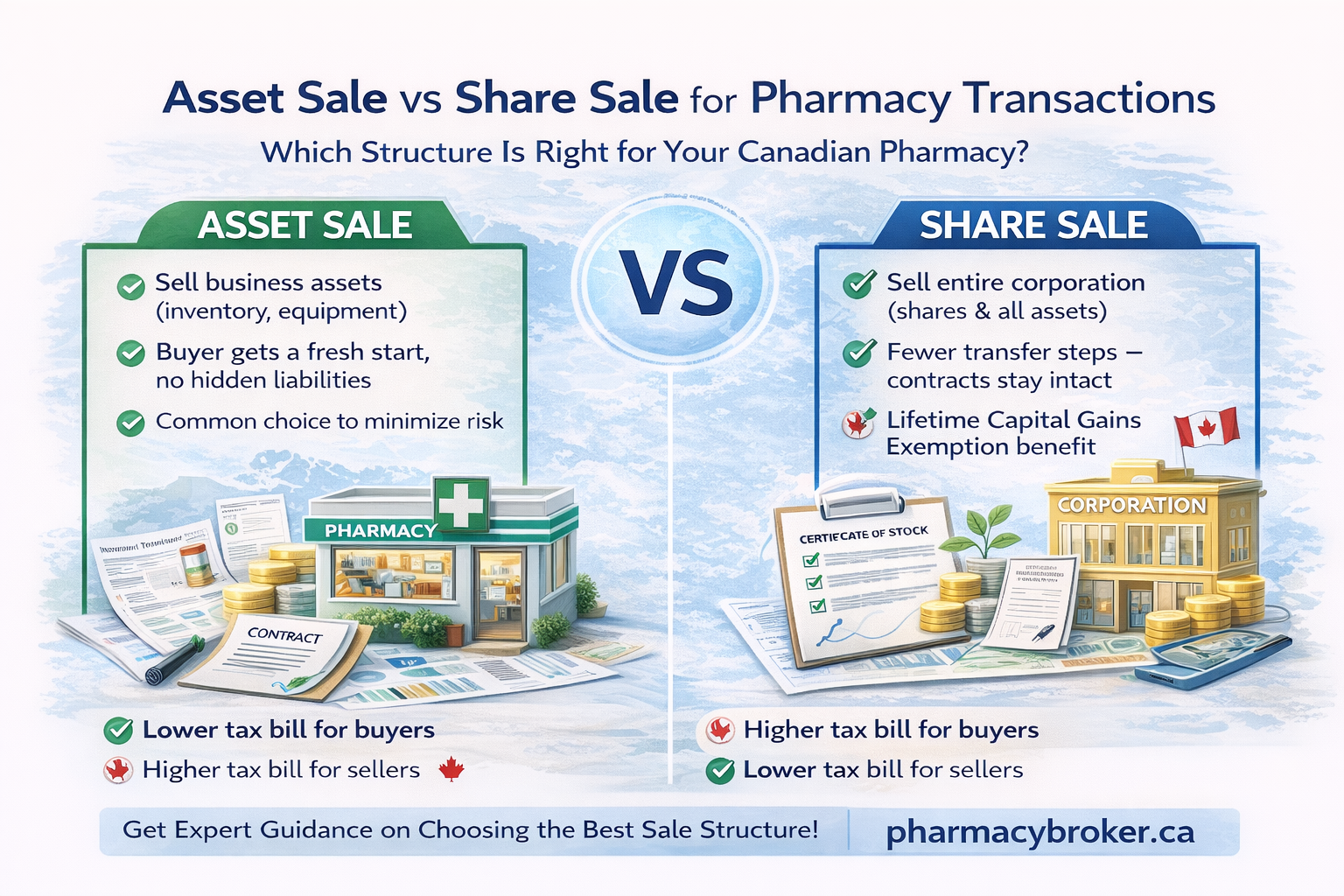
For asset sales, the lease must be assignable to the buyer.
Bank requirements:
-
- Landlord consent letter confirming willingness to assign lease
-
- No significant rent increases upon assignment
-
- Assignment provisions clearly stated in lease agreement
-
- Landlord financial stability (banks worry if landlord is in financial trouble)
Timeline consideration:
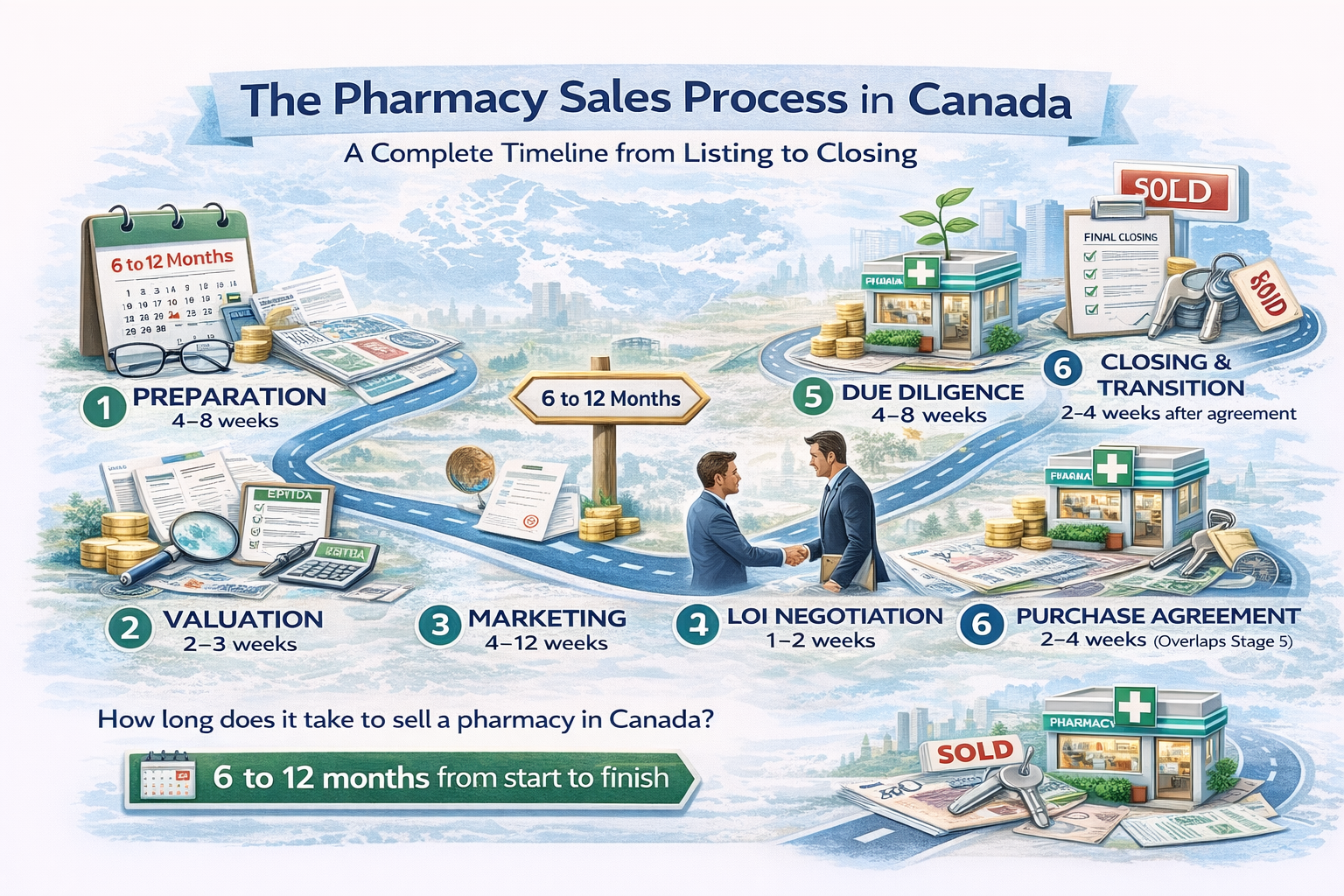
Landlord approval for lease assignment often takes 2 to 4 weeks. Banks will not fund until this approval is secured, so start this process immediately after LOI acceptance.
Location Quality Assessment
Banks assess location quality because it affects the pharmacy’s competitive position and long-term viability.
Positive location factors:
-
- Proximity to medical clinics or hospitals (within 1-2 km)
-
- High-traffic retail areas with good visibility and parking
-
- Growing or stable residential communities
-
- Limited direct pharmacy competition within 2-3 km
-
- Good demographics (aging population, higher income, insurance coverage)
Negative location factors:
-
- Isolated locations with declining foot traffic
-
- Pending closure of nearby anchor tenants or medical facilities
-
- New chain pharmacy opening nearby
-
- Demographic shifts (neighborhood transitioning to younger, healthier population)
-
- Difficult access, poor parking, or safety concerns
How location affects financing:
Strong locations support higher loan amounts because they reduce business risk. Marginal locations may result in loan reductions of 10-20% or higher equity requirements.
Personal Guarantees and Borrower Financial Strength
Personal guarantees are standard in Canadian pharmacy acquisition financing.
What Personal Guarantees Mean
A personal guarantee makes the borrower personally liable for the business debt. If the pharmacy fails and cannot repay the loan, the bank can pursue the borrower’s personal assets (home, investments, savings).
Standard personal guarantee terms:
-
- Unlimited guarantee (borrower is responsible for 100% of the debt)
-
- Joint and several (if multiple borrowers, each is responsible for the entire debt)
-
- Continuing guarantee (survives even if the business is sold or restructured)
Why banks require them:
Pharmacy goodwill value is intangible. If the business fails, the bank recovers little from selling used equipment and inventory. Personal guarantees ensure the borrower has strong incentive to make the business succeed.
Borrower’s Personal Financial Position
Banks evaluate the borrower’s personal balance sheet alongside the business financials.
What banks examine:
-
- Personal credit score: Minimum 680-700 for most pharmacy loans, with 720+ receiving better terms
-
- Net worth: Total assets minus liabilities. Banks prefer borrowers with net worth at least equal to the down payment plus 6-12 months of living expenses
-
- Existing debt obligations: Mortgage payments, car loans, credit card balances, student loans all affect debt service capacity
-
- Income stability: If the buyer currently earns income from employment, banks may include a portion of it in cash flow calculations during the transition period
-
- Liquid assets: Cash, investments, and readily accessible funds demonstrate financial cushion
Impact on loan approval:
Strong personal finances can overcome marginal business cash flow. Weak personal finances can cause rejection even with strong business performance.
Example:
Buyer A: Excellent credit (780), $300,000 net worth, minimal debt Buyer B: Fair credit (680), $100,000 net worth, $200,000 existing mortgage and student loans
For the same pharmacy acquisition, Buyer A receives better interest rates, higher loan-to-value, and faster approval. Buyer B may face higher equity requirements or loan rejection.
Typical Loan Structures and Down Payment Requirements
Understanding standard pharmacy loan structures helps both buyers and sellers set realistic expectations.
Down Payment and Loan-to-Value Ratios
Typical down payment requirements:
-
- 20% to 25% is most common for pharmacy acquisitions by qualified pharmacist buyers
-
- 0% to 15% possible for very strong businesses with excellent cash flow and experienced buyers
-
- 30% to 40% required for higher-risk situations (first-time buyers, marginal cash flow, short lease, declining scripts)
Loan-to-Value (LTV) ratios:
-
- Banks typically finance 70% to 80% of purchase price
-
- Some banks go up to 100% LTV for exceptional situations (pristine pharmacy, highly qualified buyer, strong guarantees)
What the purchase price includes:
Down payment percentages apply to the total transaction value, which includes:
-
- Goodwill and intangible assets
-
- Inventory (at cost)
-
- Equipment and fixtures
-
- Any real estate (if included)
Example structure:
Purchase price: $1,500,000 ($1,200,000 goodwill + $300,000 inventory) Bank financing (75% LTV): $1,125,000 Buyer equity required: $375,000 (25%)
Interest Rates and Loan Terms
Current pharmacy acquisition loan rates (as of 2024):
Interest rates vary based on Bank of Canada rates, borrower creditworthiness, and loan structure.
-
- Prime-based variable rates: Prime + 0.5% to Prime + 2.0% (typically Prime + 1.0% for qualified borrowers)
-
- Fixed rates: 6.0% to 8.5% depending on term length and borrower profile
-
- As of late 2024: Prime rate approximately 5.95%, so variable rates typically 6.5% to 7.5%
Loan amortization periods:
-
- 10 years is most common for pharmacy acquisition loans
-
- 7 years for smaller loans or higher-risk situations
-
- 15 years occasionally available for very strong pharmacies with experienced buyers
-
- 5 years typical for equipment financing or working capital lines
Term vs. amortization:
Many loans have 5-year terms with 10-year amortization, meaning the interest rate and payment are based on a 10-year repayment schedule, but the rate resets after 5 years. The loan fully amortizes over 10 years regardless of term resets.
Additional Financing Components
Working capital line of credit:
Banks often provide a revolving line of credit (typically $50,000 to $150,000) to manage cash flow fluctuations, pay suppliers, and cover inventory purchases.
Equipment financing:
Separate equipment loans may be available for automation, dispensing systems, or technology upgrades, often with 3 to 5-year terms.
Inventory financing:
Some banks structure inventory as a separate loan or line of credit since it turns over regularly and has liquidation value.
Differences Between Major Banks and Credit Unions
While lending criteria are similar across institutions, nuances exist between major banks and credit unions.
Major Banks (RBC, Scotiabank, TD, BMO, CIBC, National Bank)
Advantages:
-
- Specialized healthcare teams: Dedicated advisors who understand pharmacy economics and can streamline approvals
-
- Established programs: Pre-built pharmacy acquisition loan products with standard terms
-
- National reach: Can finance pharmacies anywhere in Canada
-
- Higher lending limits: Capacity to finance multi-million dollar transactions or multiple locations
-
- Competitive rates: Large banks often offer the best interest rates for well-qualified borrowers
-
- Comprehensive services: Full suite of banking, wealth management, and insurance products
Potential drawbacks:
-
- More standardized approval criteria (less flexibility for unique situations)
-
- Can be slower to adjust terms for marginal deals
-
- May require stronger financial metrics (higher DSCR, larger down payments)
Examples of bank-specific programs:
-
- Scotiabank: Dedicated Professional Plan for pharmacists with up to 100% financing for qualified buyers
-
- National Bank: Healthcare professional financing with specialized advisors
-
- RBC: Practice acquisition financing with flexible terms for health professionals
Credit Unions (Meridian, Coast Capital, Servus, Conexus, local credit unions)
Advantages:
-
- Relationship-based lending: More willing to consider full borrower story beyond just numbers
-
- Local decision-making: Branch or regional managers often have lending authority
-
- Flexibility: Can structure creative solutions for marginal deals
-
- Community focus: May prioritize keeping local pharmacies in operation
-
- Potentially faster approvals: Less bureaucratic layers for smaller loans
Potential considerations:
-
- Higher interest rates: Often 0.25% to 0.75% higher than major banks
-
- Lower lending limits: May cap loans at $1 to $2 million depending on credit union size
-
- Regional limitations: Credit unions typically only lend in their operating provinces
-
- Fewer specialized healthcare advisors: May have less pharmacy-specific expertise
When to Choose Each
Choose major banks if:
-
- You have strong credit and financial profile
-
- The pharmacy has excellent cash flow and DSCR well above 1.25x
-
- You want the lowest possible interest rate
-
- You need a large loan (over $2 million)
-
- You prefer working with specialists who understand pharmacy transactions
Choose credit unions if:
-
- Your financial profile is slightly below major bank thresholds
-
- You value personal relationships and local decision-making
-
- The pharmacy is in a smaller community where the credit union operates
-
- You need more flexible terms or creative structuring
-
- You have existing relationships with the credit union
Consider both:
Many buyers approach 2 to 3 lenders simultaneously to compare terms and rates. This is acceptable and common practice.
Provincial Considerations for Pharmacy Financing
Provincial differences in pharmacy economics affect how banks evaluate financing applications.
British Columbia:
-
- Dispensing fee cap of $11.00 constrains revenue
-
- PharmaCare income-based deductible creates cash-pay seasonality
-
- Rural incentive programs add modest revenue support for qualifying pharmacies
-
- Banks may apply slightly more conservative DSCR requirements (1.30x) due to fee constraints
Alberta:
-
- Higher dispensing fees ($12.15) support stronger margins
-
- Professional service billing opportunities increase revenue potential
-
- Banks view Alberta pharmacies favorably due to better reimbursement environment
-
- May accept DSCR as low as 1.20x for exceptional pharmacies
Ontario:
-
- Large market with high pharmacy density and competition
-
- Generic rebate ban (prohibition on rebates over 20%) has compressed margins
-
- ODB provides high volume but lower margin revenue
-
- Banks scrutinize competitive positioning and market share carefully
-
- Rural dispensing fee uplift helps support pharmacies in smaller communities
Quebec:
-
- Regulated professional allowance caps affect profitability
-
- Severe pharmacist shortage (12%+ vacancy rate) drives up labor costs
-
- Banks may require higher equity or DSCR due to workforce pressure
-
- Language requirements and regulatory environment add complexity
Other Provinces:
-
- Smaller markets with less pharmacy density
-
- Rural pharmacies often essential community infrastructure
-
- Banks may accept marginal DSCR if pharmacy is the only one serving the community
-
- Credit unions often more active than major banks in smaller provinces
Practical Steps for Buyers to Secure Financing
Step 1 (6-12 months before purchase): Review personal credit report and address any issues. Pay down high-interest debt.
Step 2 (3-6 months before): Accumulate down payment funds. Verify liquidity and source of funds.
Step 3 (3-4 months before): Meet with 2-3 lendersThis is a critical step for pharmacy financing Canada success. (banks and credit unions) to discuss pharmacy financing programs and get pre-qualification.
Step 4: Provide lenders with personal financial statements, credit authorization, and preliminary business plan.
Step 5 (upon identifying target pharmacy): Share pharmacy financial information with your lender for preliminary approval.
Step 6: Obtain conditional loan approval letter before submitting Letter of Intent to seller.
Step 7 (after LOI acceptance): Submit complete loan application with:
-
- Three years of pharmacy financial statements
-
- Business plan and cash flow projections
-
- Lease documentation
-
- Personal guarantee
-
- Proof of down payment
Step 8: Work with your lender through underwriting process, providing additional documentation as requested.
Step 9: Obtain final loan commitment letter (typically 30-45 days after full application submission).
Step 10: Coordinate closing with your lawyer, seller’s lawyer, and lender to ensure funds are available on closing day.
Practical Guidance for Sellers
Sellers can significantly improve deal success rates by understanding buyer financing challenges.
Prepare Financial Documentation
Provide organized, complete financial records:
-
- Three years of financial statements prepared by accountant
-
- Normalized EBITDA schedule with clear explanations
-
- Monthly prescription count reports
-
- Payer mix analysis
-
- Lease documentation
Clean, organized financials speed buyer approvals.
Price Realistically Based on Bank-Adjusted EBITDA
Work with your broker to ensure asking price is supportable by bank-adjusted (not just broker-normalized) EBITDA. Overpricing based on aggressive add-backs leads to buyer financing failures and collapsed deals.
Address Lease Issues Early
If your lease has less than 5 years remaining, negotiate renewal or extension before listing. Buyers cannot secure adequate financing without lease certainty.
Be Flexible on Structure
Consider vendor take-back financing (VTB) (seller-provided loan for portion of purchase price) if it helps bridge buyer financing gaps. A 10% to 20% vendor take-back for 2 to 3 years can make marginal deals work.
Qualify Buyers Before Exclusivity
Require proof of financing pre-approval or proof of funds before granting exclusivity periods. Do not waste months on buyers who cannot actually secure financing.
Conclusion: Financing Determines Deal Success
Understanding Canadian bank financing criteria is not optional for successful pharmacy transactions. Sellers who ignore how banks evaluate their businesses price them incorrectly and attract unqualified buyers. For those seeking pharmacy financing Canada, proper preparation is key. Buyers who do not prepare financially waste time pursuing pharmacies they cannot afford.The good news is that pharmacy financing follows predictable patterns. Banks have clear criteria. Metrics like DSCR provide objective thresholds. Preparing properly increases approval probability dramatically.
Start early. Organize your financials. Understand what banks will actually accept in EBITDA calculations. Know your DSCR. Secure your lease. And work with lenders who understand pharmacy transactions.
The difference between a deal that closes smoothly and one that collapses often comes down to financing preparation that started months before the first offer.
If you are buying or selling a pharmacy and need guidance on positioning the business for successful financing, our team works with buyers and sellers across Canada to structure transactions that banks approve. Contact us for a confidential consultation.
Scotiabank Scotiabank’s Healthcare+ program for pharmacists
National Bank provides financing solutions for healthcare professionals
CIBC’s offers healthcare services financing
TD Professional Banking: Tailored business solutions and financing for healthcare professionals.

Arash Pourzare, Pharm.D., is a Canadian pharmacist, pharmacy owner, and pharmacy business consultant. Through PharmacyBroker.ca, he helps pharmacists and entrepreneurs value, buy, sell, and grow pharmacy businesses across Canada.