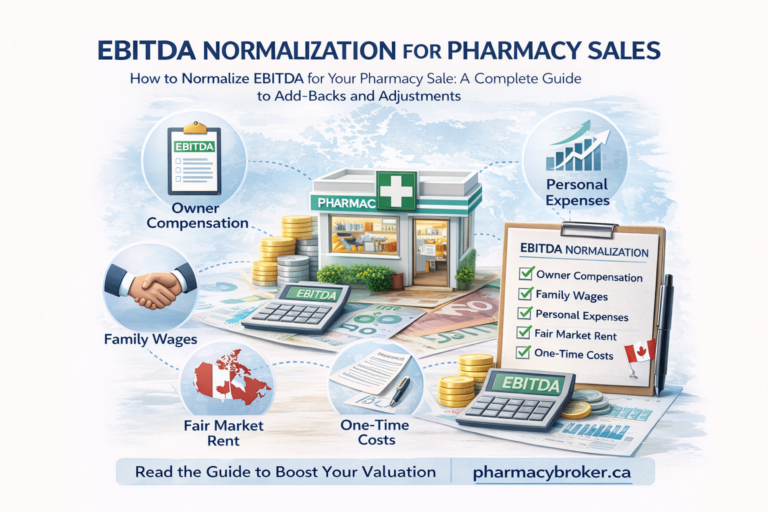
How to Normalize EBITDA for Your Pharmacy Sale: A Complete Guide to Add-Backs and Adjustments
The financial statements your accountant prepares each year tell one story. The normalized financials that pharmacy buyers want to see tell a very different story.
If you are planning to sell your independent pharmacy in Canada, understanding EBITDA normalization is not optional. It is the single most important financial exercise that determines your asking price, influences buyer interest, and affects how much financing banks will approve.
Most pharmacy owners leave significant money on the table because they do not properly normalize their earnings. They present raw financials that understate the true earning capacity of their business. Buyers see lower profitability and make lower offers. Or worse, they walk away entirely because the numbers do not support their financing needs.
This guide explains exactly how to normalize your pharmacy’s EBITDA for sale, what adjustments are legitimate, how to document them properly, and what buyers and banks will actually accept.
Quick Summary: What You Will Learn
- What EBITDA normalization means and why it matters for pharmacy sales
- The difference between normalized EBITDA and Seller’s Discretionary Earnings (SDE)
- Seven categories of legitimate add-backs for Canadian pharmacy valuations
- How to document adjustments so buyers and banks accept them
- Common normalization mistakes that hurt your sale price
- What banks will and will not accept in their EBITDA calculations

What EBITDA Normalization Actually Means
EBITDA normalization is the process of adjusting your pharmacy’s reported earnings to reflect the true, sustainable cash flow a new owner can expect to generate.
Your current financial statements include many expenses that are specific to you as the current owner. Some are discretionary personal choices. Others are one-time events that will not repeat. Many reflect your particular compensation structure or how you have chosen to run the business.
A buyer does not care what you chose to pay yourself. They care what the business will generate for them after paying a fair market wage to operate the pharmacy.
Normalization removes or adjusts these owner-specific and non-recurring items to calculate maintainable EBITDA. This is the EBITDA figure that:
- Represents sustainable, ongoing profitability
- Can be consistently achieved by a competent new owner
- Forms the basis for your pharmacy’s valuation
- Determines how much financing buyers can secure
Think of it this way: your accountant prepares statements to minimize your taxes. Your broker or business valuator prepares normalized statements to maximize your sale price. These are opposite objectives that produce very different numbers.
Normalized EBITDA vs. Seller’s Discretionary Earnings (SDE)
Before we dive into specific add-backs, you need to understand two related but different concepts that pharmacy buyers use.
Normalized EBITDA is your operating profit after paying a market-rate manager or pharmacist to run the business, but before interest, taxes, depreciation, and amortization. This metric assumes the new owner is not working in the business full-time.
Seller’s Discretionary Earnings (SDE) adds back the total owner compensation (salary, benefits, distributions) to EBITDA. This metric represents the total cash benefit an owner-operator receives. SDE is used when the buyer plans to work as the primary pharmacist.
For most independent pharmacy sales in Canada, both metrics matter:
- Corporate buyers or investors use normalized EBITDA (they will hire a manager)
- Pharmacist buyers who will work in the pharmacy use SDE
- Banks often want to see both to understand different buyer scenarios
Example:
Your pharmacy shows:
- Revenue: $3,500,000
- Net Income (after owner salary): $180,000
- Add back owner salary: $150,000
- Add back interest, taxes, depreciation: $50,000
- EBITDA before normalization: $380,000
Now normalize:
- Add back owner’s discretionary spending: $25,000
- Subtract market pharmacist-manager salary: ($120,000)
- Normalized EBITDA: $285,000
For SDE calculation:
- Take EBITDA before normalization: $380,000
- Add back discretionary spending: $25,000
- SDE: $405,000
A corporate buyer might value your pharmacy at 5x normalized EBITDA = $1,425,000. An owner-operator might value it at 2.5x SDE = $1,012,500 to 3x SDE = $1,215,000. Understanding both helps you price competitively for different buyer types.

The Seven Categories of Legitimate Add-Backs
Canadian pharmacy valuations recognize seven main categories of expenses that can be legitimately added back to EBITDA. Let’s examine each in detail.
1. Owner Compensation Adjustments
This is typically the largest normalization adjustment for independent pharmacies.
What to add back:
- The difference between what you pay yourself and what a market-rate replacement would cost
- Bonuses or profit distributions beyond reasonable compensation
- Benefits you receive that exceed standard employee benefits
- Retirement contributions beyond typical employer matches
Example: You pay yourself $180,000 as owner-pharmacist-manager. A competent pharmacist-manager in your market earns $115,000 to $125,000. You can add back $55,000 to $65,000 as excess owner compensation.
Documentation required: Salary surveys from your provincial pharmacy association, job postings for similar roles, or compensation data from reputable sources.
Important: You cannot add back the entire owner salary if you work full-time in the pharmacy. You can only add back the amount above market rate. Buyers need someone to fill your role.
2. Family Member Wages
Many independent pharmacy owners employ family members. These wages may be above market rate for the actual work performed, or the family member may not be essential to operations.
What to add back:
- Wages paid to family members who do not work in the business
- Amounts paid above market rate for the actual duties performed
- Salaries for family members whose roles can be eliminated or absorbed
Example: Your spouse handles bookkeeping 10 hours per week and receives $45,000 annually. A part-time bookkeeper costs $18,000. Add back $27,000.
Documentation required: Job descriptions, time records, and comparable wage data for similar roles.
Caution: If your family member performs essential work (like a spouse who is the only other pharmacist), you cannot add back their entire salary unless the buyer confirms they do not need that position filled.
3. Personal and Discretionary Expenses
Independent pharmacy owners often run personal expenses through the business for tax efficiency. These expenses reduce reported EBITDA but will not continue under new ownership.
Common personal expenses to add back:
- Personal vehicle costs (if business use is minimal)
- Personal mobile phone and internet at home
- Meals and entertainment beyond reasonable business purposes
- Travel to conferences in desirable locations with minimal business benefit
- Country club or gym memberships
- Professional development far exceeding industry norms
- Home office expenses if you do not actually work from home
Example: Your financials show $22,000 in vehicle expenses, but your pharmacy has a delivery vehicle that costs $8,000 and your personal vehicle use is $14,000. Add back $14,000.
Documentation required: Detailed expense breakdown showing business vs. personal use, credit card statements, and receipts.
Warning: Be conservative and honest. Buyers will scrutinize these during due diligence. Aggressive claims hurt credibility.
4. One-Time and Non-Recurring Expenses
Expenses that happened once and will not repeat under normal operations should be added back.
Examples of legitimate one-time add-backs:
- Legal fees for a specific dispute or one-time contract negotiation
- Major renovation or remodeling costs (capital improvements)
- Costs related to the sale itself (broker fees, legal costs for the transaction)
- Unusually high bad debt write-offs from a specific event
- Technology implementation costs (new pharmacy software, hardware)
- Relocation expenses if you temporarily moved locations
- Severance payments to terminated employees
- Insurance claim deductibles from a one-time loss
Example: You renovated the dispensary for $45,000 last year. This was a capital improvement that will not recur. Add back $45,000.
Documentation required: Invoices clearly showing the one-time nature of the expense, explanatory notes in your normalization schedule.
Important distinction: Regular maintenance and repairs are ongoing operating expenses. You cannot add these back. Only true non-recurring capital items qualify.
5. Rent Normalization
If you own the building your pharmacy occupies and rent it to yourself through a separate company, the rent you charge affects EBITDA.
When to normalize rent:
- If you charge below-market rent to increase business EBITDA (knowing you receive the rent in another entity)
- If you charge above-market rent to shift income to a different tax structure
How to normalize: Adjust EBITDA to reflect fair market rent for comparable commercial space in your area.
Example 1 – Below market: You charge your pharmacy $2,000/month ($24,000/year) but comparable space rents for $4,500/month ($54,000/year). You must reduce EBITDA by $30,000 to show realistic costs.
Example 2 – Above market: You charge $8,000/month ($96,000/year) but market rent is $5,000/month ($60,000/year). Add back $36,000 to EBITDA.
Documentation required: Commercial lease comparables (from real estate agents), property tax and operating cost analysis, independent appraisal of fair market rent.
Critical note: Most buyers will not purchase your building, so showing realistic rent is essential. If rent is significantly below market and the landlord (you) is selling, the buyer may face a sharp rent increase or need to relocate.
6. Extraordinary Income Adjustments
Just as you add back unusual expenses, you must remove unusual income that will not continue.
Examples:
- One-time manufacturer signing bonuses
- Government COVID-19 subsidies or emergency payments
- Insurance proceeds from a casualty loss
- Sale of used equipment above book value
- Discontinued service lines with temporary high revenue
Example: During COVID-19, your pharmacy received $35,000 in government wage subsidies. This will not recur. Subtract $35,000 from EBITDA (or add it to expenses, same result).
Why this matters: Overstating ongoing income leads buyers to overvalue the pharmacy, which falls apart during due diligence and destroys trust.
7. Professional Fees Related to the Sale
Expenses you incur specifically to facilitate the sale should be added back since they are one-time costs.
What qualifies:
- Broker commission and fees
- Legal fees for sale transaction
- Accounting fees for preparing normalized financial statements
- Business valuation or appraisal costs
- Due diligence costs (environmental assessments if required)
Example: You pay a broker $60,000 commission and $15,000 in legal fees. Add back $75,000.
Timing note: These expenses often occur in the year of sale, so if you are presenting three years of historical EBITDA, this adjustment only applies to year three.
How to Document Your Adjustments Properly
Having legitimate add-backs is not enough. You must document them so buyers and their advisors accept them without suspicion.
Create a normalization schedule in a clear spreadsheet format:
| Adjustment Category | Year 1 | Year 2 | Year 3 | Supporting Documentation |
| Reported EBITDA | $280,000 | $295,000 | $310,000 | Financial statements |
| Owner excess compensation | $45,000 | $48,000 | $50,000 | Salary surveys, market data |
| Personal vehicle expenses | $12,000 | $13,500 | $14,000 | Mileage logs, expense reports |
| One-time legal fees | $0 | $18,000 | $0 | Legal invoices |
| Rent normalization | $15,000 | $15,000 | $15,000 | Lease comparables |
| Normalized EBITDA | $352,000 | $389,500 | $389,000 |
Best practices for documentation:
- Provide a written explanation for every adjustment over $5,000
- Attach supporting documents (invoices, comparables, surveys)
- Be consistent across all three years
- Use conservative estimates when ranges exist
- Highlight adjustments in your financial statement notes
- Have your accountant review and sign off on the normalization schedule
Buyers who see well-documented adjustments gain confidence. Buyers who see vague or unsupported claims become skeptical and reduce offers.
What Banks Will and Will Not Accept
Here is the reality: your broker might accept aggressive normalizations to maximize listing price, but the buyer’s bank will be far more conservative.
Banks perform their own EBITDA normalization for lending purposes. They calculate bank-adjusted EBITDA, which determines how much they will lend.
Add-backs banks typically accept:
- Owner compensation above market (with solid comparables)
- Well-documented personal expenses (with receipts)
- Clearly one-time expenses (legal, renovation, etc.)
- Rent adjustments (with independent market data)
Add-backs banks often reject or discount:
- Manufacturer rebates or professional allowances: If a significant portion of your profit comes from rebates, banks may discount or exclude this income unless you have long-term contracts guaranteeing it will continue
- Projected cost savings: “The new owner could reduce staff” or “I am overpaying for supplies” are speculative. Banks want historical facts
- Family member wages without documentation: If you cannot prove market rates, banks will not accept the adjustment
- Personal expenses without business justification: If your “business meals” exceed 5% of revenue, banks will be skeptical
Example of bank conservatism:
Your broker shows normalized EBITDA of $375,000 including:
- $50,000 owner excess compensation (well documented) ✓
- $18,000 one-time legal fees (invoices provided) ✓
- $35,000 generic rebate income (no ongoing contract) ✗
- $22,000 “could reduce delivery costs” (projection, not historical) ✗
Bank-adjusted EBITDA: $375,000 – $35,000 – $22,000 = $318,000
This lower number affects the buyer’s Debt Service Coverage Ratio and loan amount. If the buyer needed $318,000 to qualify but their bank only recognizes $318,000 EBITDA, the financing works. But if your asking price assumes $375,000, there is a gap.
Lesson: Align your normalization with what banks will accept to avoid financing delays that kill deals.
Practical Steps to Normalize Your Pharmacy’s EBITDA
Step 1: Gather three complete years of financial statements (profit and loss, general ledger detail).
Step 2: Start with net income and calculate raw EBITDA by adding back interest, taxes, depreciation, and amortization.
Step 3: Review every expense line item over $5,000 annually and ask: “Is this expense necessary for a new owner to operate the pharmacy?”
Step 4: Identify and quantify each adjustment category (owner compensation, personal expenses, one-time costs, rent, family wages).
Step 5: Research market data to support your adjustments (salary surveys, rent comparables, industry benchmarks).
Step 6: Create a detailed normalization schedule showing each adjustment with explanation and supporting documentation.
Step 7: Have your accountant review the schedule for accuracy and reasonableness.
Step 8: Calculate both normalized EBITDA (for investor buyers) and SDE (for owner-operator buyers).
Step 9: Prepare a one-page summary explaining your normalization approach and key adjustments.
Step 10: Include the normalization schedule and supporting documents in your Confidential Information Memorandum (CIM) that pharmacy brokers provide to qualified buyers.
Common EBITDA Normalization Mistakes That Hurt Sale Price
Mistake 1: Adding back essential operating expenses Some owners try to add back expenses they simply do not like paying but that are necessary. Marketing, ongoing training, and reasonable professional development are operating costs, not discretionary.
Mistake 2: Inconsistent adjustments across years If you add back $40,000 in personal expenses in Year 3 but only $8,000 in Years 1 and 2, buyers will question the inconsistency. Be consistent or explain changes clearly.
Mistake 3: Undocumented adjustments Stating “I add back $55,000 in personal expenses” without receipts, logs, or detail creates immediate buyer skepticism and often results in those add-backs being rejected entirely.
Mistake 4: Overly aggressive add-backs Claiming every possible adjustment to show maximum EBITDA usually backfires during due diligence. Buyers reduce offers or walk away when they find the normalized numbers were unrealistic.
Mistake 5: Ignoring negative adjustments Normalization works both ways. If you had unusually high one-time income, you must remove it. If your rent is below market and will increase under new ownership, EBITDA must be reduced. Honest normalization builds trust.
Mistake 6: Not addressing rebate dependency If 30% of your EBITDA comes from manufacturer rebates in provinces where they are still permitted, you must address sustainability. Banks and sophisticated buyers will discount this income unless you prove it is contractual and ongoing.
Mistake 7: Normalizing too late Start preparing normalized financials 12 to 24 months before listing. This gives you time to adjust operations, clean up expenses, and establish a pattern buyers will trust. Last-minute normalization looks opportunistic.
Conclusion: Normalization Is Not Optional
Every dollar of properly documented EBITDA add-back translates directly to $4 to $6 in sale price (depending on your valuation multiple).
If you can legitimately add back $50,000 through proper normalization and your pharmacy sells at 5x EBITDA, that is $250,000 in additional sale proceeds. For most pharmacy owners, this represents the difference between a comfortable retirement and a stressful one.
But normalization must be done correctly. Aggressive adjustments without documentation destroy buyer confidence and lead to lower offers, not higher ones. Conservative, well-supported adjustments build trust and justify premium pricing.
Work with your accountant and pharmacy valuation specialist to prepare your normalized financials at least one year before you plan to sell. The investment in proper preparation pays for itself many times over.
If you are preparing to sell your pharmacy and need expert guidance on EBITDA normalization and financial presentation, our team provides comprehensive valuation and sale preparation services. Contact us for a confidential consultation.
Canadian Business Valuation Standards
About the Author

Arash Pourzare, Pharm.D., is a Canadian pharmacist, pharmacy owner, and pharmacy business consultant. Through PharmacyBroker.ca, he helps pharmacists and entrepreneurs value, buy, sell, and grow pharmacy businesses across Canada.