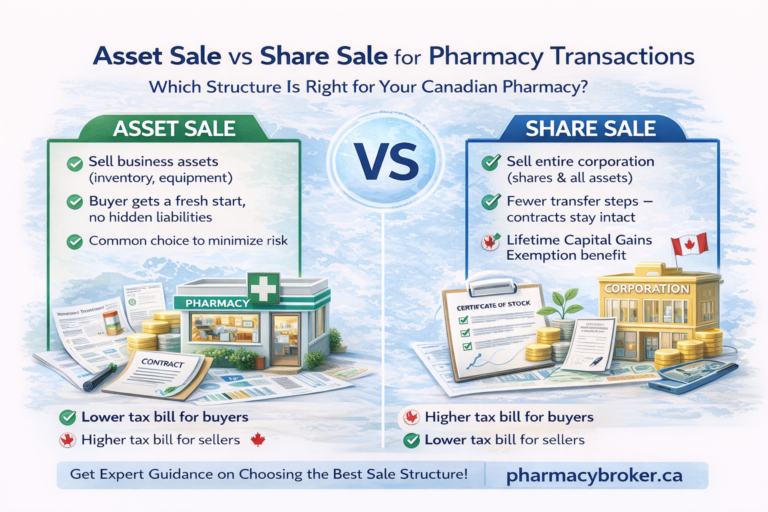
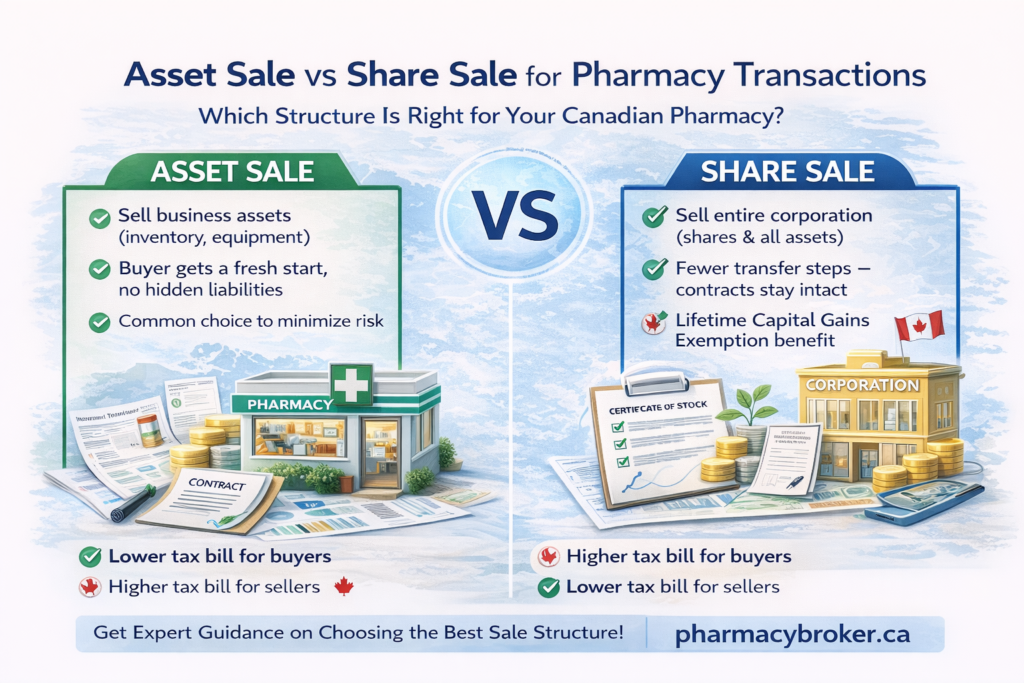
Asset Sale vs Share Sale for Pharmacy Transactions: Which Structure Is Right for Your Canadian Pharmacy?
One of the most consequential decisions you will make when selling your pharmacy has nothing to do with price, timing, or finding the right buyer.
It is how you structure the transaction itself.
Every pharmacy sale in Canada happens through one of two legal structures: an asset sale or a share sale. The structure you choose affects your tax bill, your liability exposure after closing, the complexity of the transaction, and sometimes whether the deal closes at all.
Most pharmacy owners do not understand the difference until they are deep in negotiations. By then, changing course is difficult or impossible. Sellers push for share sales to minimize taxes. Buyers insist on asset sales to limit liability. The structure becomes a negotiation point that can make or break deals.
Quick Summary: What You Will Learn
- The fundamental legal difference between asset and share sales
- Why most pharmacy buyers strongly prefer asset sales
- How share sales can save sellers significant taxes through the Lifetime Capital Gains Exemption
- Liability and risk differences that matter after closing
- Administrative complexity and third-party consent requirements
- How to negotiate structure as part of your deal terms
What Is an Asset Sale?
In an asset sale, the buyer purchases specific assets of your pharmacy business rather than buying your corporation itself. The assets typically include:
- Prescription files (patient records and refill history)
- Goodwill and trade name
- Inventory (at cost, counted at closing)
- Equipment and fixtures (dispensing systems, shelving, computers)
- Leasehold improvements
- Intellectual property (if any)
The buyer does not acquire your corporate entity. Your pharmacy corporation continues to exist after the sale. It simply no longer owns the operating assets. You (the seller) remain responsible for winding down the corporation, paying any remaining liabilities, and eventually dissolving it.
The buyer typically forms a new corporation or uses an existing entity to purchase the assets. They get a fresh start with clean books and no historical baggage.
Example: You own “Maple Pharmacy Ltd.” The buyer forms “New Pharmacy Corp.” and purchases the prescription files, inventory, and equipment from Maple Pharmacy Ltd. for $1.5 million. Maple Pharmacy Ltd. receives the cash but continues to exist (with you as the shareholder) until you dissolve it after settling any remaining obligations.
What Is a Share Sale?
In a share sale, the buyer purchases all the shares of your pharmacy corporation. They acquire the entire legal entity, including all its assets and all its liabilities.
After closing, the corporation continues operating under new ownership. The corporate name, tax numbers, bank accounts, contracts, licenses, and everything else remain unchanged. Only the shareholder changes.
From an operational perspective, share sales appear seamless. Supplier contracts, lease agreements, pharmacy software licenses, and third-party billing arrangements continue without requiring assignment or approval because the contracting party (your corporation) has not changed.
Example: You own 100% of the shares of “Maple Pharmacy Ltd.” The buyer purchases all your shares for $1.5 million. Maple Pharmacy Ltd. continues to exist exactly as before, but now the buyer owns the shares instead of you.

Why Buyers Strongly Prefer Asset Sales
Asset sales are widely considered the safer, more buyer-friendly structure for pharmacy acquisitions. The overwhelming majority of pharmacy sales in Canada are structured as asset sales because they offer buyers significant liability protection.
Liability Protection
The primary advantage for buyers is that they do not inherit the seller’s historical liabilities. When you buy assets, you get exactly what you negotiate for and nothing else.
Liabilities left behind in asset sales:
- Past tax debts or unfiled returns
- Outstanding lawsuits or legal claims
- Employee issues (wrongful dismissal claims, unpaid wages)
- Supplier debts or disputed invoices
- Regulatory violations or college of pharmacy sanctions
- Third-party billing errors or insurance clawbacks
- Privacy breaches (PHIPA violations in Ontario, PIPA in Alberta/BC)
- Narcotics discrepancies or controlled substance tracking issues
- Undisclosed environmental contamination
In a pharmacy context, these risks are not theoretical. Regulatory compliance issues are common. Third-party insurers regularly audit and claw back payments for prescriptions dispensed years earlier. Privacy laws carry significant penalties. Narcotics tracking errors can result in college investigations.
An asset buyer walks away from all of this. If your college of pharmacy discovers a dispensing error from two years ago after the sale closes, that is your problem as the seller, not the buyer’s.
Selective Asset Acquisition
Asset sales allow buyers to cherry-pick what they want and exclude what they do not.
Common exclusions in pharmacy asset sales:
- Outdated or broken equipment
- Slow-moving or obsolete inventory
- Accounts receivable (the seller keeps these and collects them)
- Non-core business lines the buyer does not want
- Employees the buyer chooses not to hire
- Liabilities of any kind
Example: Your pharmacy has $350,000 in inventory, but $40,000 is near-expiry or slow-moving products. In an asset sale, the buyer can negotiate to purchase only $310,000 of current, saleable inventory and leave the rest with you.
Greater Control Over Inventory Valuation
Inventory represents a significant portion of pharmacy transaction value, often $100,000 to $400,000. Asset sales give buyers more control over what they pay for.
The purchase agreement typically specifies:
- A joint physical count at closing
- Exclusion of expired or damaged products
- Reduced payment for near-expiry items (products expiring within 3-6 months)
- Separate valuation for narcotics and controlled substances
- Verification against current wholesaler cost
This ensures buyers pay only for real, usable inventory value rather than accepting a book value that may include write-offs the seller has not yet recorded.
Cleaner Operational Transition
Despite requiring more paperwork, asset sales often lead to smoother long-term operations because the buyer starts fresh.
The buyer establishes:
- New corporate entity with clean accounting records
- New employee contracts and benefit structures
- New supplier accounts and pricing agreements
- New banking relationships
- Fresh pharmacy license and regulatory compliance history
- Updated software configurations and workflows
While the buyer must handle lease assignments, license transfers, and third-party billing enrollment, these administrative steps force verification that everything is in order. Problems surface and get resolved before closing rather than appearing as surprises months later.
Why Sellers Often Prefer Share Sales
From a seller’s perspective, share sales offer one compelling advantage: tax efficiency.
Lifetime Capital Gains Exemption (LCGE)
The LCGE is the primary reason many pharmacy owners want share sales. For 2026, the exemption allows Canadian residents to shelter up to $1,275,000 in capital gains from the sale of qualified small business corporation shares from taxation.
How it works:
If you sell the shares of your pharmacy corporation and it qualifies as a small business corporation, up to $1,275,000 of your gain is tax-free. The remaining gain (if any) is taxed at capital gains rates (50% inclusion rate as of 2026, though this rate can change).
Example:
You bought your pharmacy 20 years ago for $200,000. You sell the shares today for $1,500,000.
- Capital gain: $1,300,000
- LCGE exemption: $1,275,000 (tax-free)
- Taxable gain: $25,000
- Taxable amount (50% inclusion): $12,500
- Tax at 50% marginal rate: approximately $6,250
Compare this to an asset sale where the gain is typically taxed as business income or at higher rates on certain assets. The tax savings can be $100,000 to $400,000 or more depending on your province and tax situation.
Qualification Requirements for LCGE
Not all pharmacy corporations qualify. The shares must meet specific criteria:
- The corporation must be a Canadian-controlled private corporation (CCPC)
- At least 90% of the corporation’s assets must be used in an active business (not passive investments) at the time of sale
- For the 24 months before sale, at least 50% of assets must have been used in active business
- The shares must have been owned by you or a related person for at least 24 months before sale
Most active pharmacy corporations qualify, but if you have accumulated significant passive investments inside your pharmacy corporation (like a large GIC portfolio or real estate holdings), you may not meet the 90% active asset test.
Critical planning point: Consult with your accountant at least 24 months before selling to ensure your corporation structure qualifies for the LCGE. Purifying the corporation (moving passive assets out) takes time and must be done properly.
Simpler Contractual Transfer
Share sales avoid the need to assign or transfer many contracts because the corporation (the contracting party) does not change.
Contracts that continue automatically in share sales:
- Commercial lease (the corporation remains the tenant)
- Supplier agreements (the corporation remains the customer)
- Pharmacy software licenses (same licensee)
- Third-party billing arrangements (same pharmacy entity)
- Insurance policies (same insured)
This reduces administrative burden and avoids potential roadblocks where landlords, franchisors, or suppliers might refuse to consent to assignment or demand unfavorable new terms.
Potential Price Leverage
Because sellers often strongly prefer share sales for tax reasons, this can become a negotiation tool.
If a buyer is willing to accept a share purchase (taking on the additional risk), the seller might agree to:
- A slightly lower purchase price
- More favorable working capital adjustments
- Vendor take-back financing (seller provides part of the purchase price as a loan)
- Longer transition support period
- Stronger indemnity provisions to protect the buyer
The seller’s tax savings can be large enough that giving up $50,000 to $100,000 in price or offering better terms still results in more net cash than an asset sale at full price.
Real-World Negotiation Scenario: When Structure Drives Price
The interplay between transaction structure and price often plays out in predictable patterns. Here is how a typical negotiation might unfold when buyer and seller have opposing preferences:
The Setup:
Sarah owns a successful independent pharmacy in Ontario generating $400,000 in normalized EBITDA. Based on comparable sales, the fair market value is approximately $2,000,000 (5x EBITDA multiple) in an asset sale.
Sarah’s accountant calculates that a share sale using the Lifetime Capital Gains Exemption would save her approximately $280,000 in taxes compared to an asset sale. This is a substantial difference that would significantly impact her retirement plans.
David, a pharmacist buyer, has his financing pre-approved through his bank. However, his bank has made it clear they strongly prefer asset purchases due to liability concerns and have built their loan structure around acquiring assets, not shares.
Round 1: Initial Positions
Sarah lists the pharmacy at $2,000,000 as a share sale. David submits a Letter of Intent at $1,950,000 as an asset sale.
Sarah counters: “I understand your preference for an asset sale, but that structure will cost me $280,000 in additional taxes. I’m willing to accept an asset sale, but the price needs to be $2,280,000 to compensate for my tax liability.”
David responds: “I appreciate your tax situation, but the market value is $2,000,000. I cannot justify paying $280,000 more just to cover your tax bill. That is not how valuations work.”
Stalemate.
Round 2: Finding Middle Ground
Sarah’s broker suggests a compromise approach. Sarah reconsiders her position and proposes:
“David, I recognize that asking you to cover my entire tax difference is unrealistic. Here’s what I propose: I’ll accept the asset sale structure at $2,100,000 – that is $100,000 above market value. This splits the tax burden. I absorb $180,000 of the tax hit, and you help me with $100,000 of it. In exchange, I’ll provide three months of transition support instead of the standard four weeks, and I’ll stay on part-time to ensure continuity.”
David counters: “I understand the compromise, but my bank’s valuation still shows $2,000,000 for the business. Paying $100,000 over market creates a financing gap. However, I’m willing to meet you halfway. I’ll pay $2,050,000 as an asset sale – that is $50,000 above market. You absorb the majority of the tax impact, but I recognize your situation and compensate you partially.”
Round 3: The Final Structure
After further discussion, they agree on $2,050,000 as an asset purchase with the following terms:
- Purchase price: $2,050,000 (asset sale)
- Seller transition support: 8 weeks full-time, then 8 weeks part-time (20 hours/week)
- Seller consulting availability: 6 months on-call support for questions
- Inventory: Valued generously (buyer accepts seller’s count for items within 6 months of expiry at 75% of cost rather than the standard 50%)
The Math:
For Sarah (Seller):
- Asset sale proceeds: $2,050,000
- Tax on asset sale (estimated 40% effective rate on gain): -$680,000
- Net after tax: $1,370,000
- Compare to share sale at $2,000,000 with LCGE:
- Share sale proceeds: $2,000,000
- Tax with LCGE (estimated): -$400,000
- Net after tax: $1,600,000
Sarah nets $230,000 less than she would have with a pure share sale, but David moved $50,000 toward her position. She absorbs most of the structure cost but receives meaningful help.
For David (Buyer):
- Pays $50,000 above market value
- But gains: asset purchase with limited liability, favorable inventory valuation (worth approximately $15,000), and exceptional transition support (worth approximately $25,000 in avoided complications)
- Net premium over market: ~$10,000 after factoring in transition value
- Gets his preferred structure with bank approval
The Outcome:
Both parties compromise. Sarah does not get her full tax burden covered, but David acknowledges her situation by moving price and providing favorable terms. David pays slightly above market but gets his required structure and exceptional support that reduces his risk.
The deal closes successfully.
Key Lesson:
When structure preferences conflict, creative negotiation can bridge the gap. Sellers should not expect buyers to absorb 100% of their tax burden from structure choices. Buyers should recognize that sellers face real financial consequences and some accommodation may be necessary to close the deal.
The most successful negotiations involve both parties sharing the burden created by structure requirements and using non-price terms (transition support, inventory valuation methods, payment timing) to create additional value that makes the compromise acceptable.

The Risks Buyers Face in Share Sales
While share sales offer administrative simplicity, buyers inherit significant risks.
Assumption of All Liabilities
The buyer becomes responsible for everything, including unknown or undisclosed liabilities.
Common hidden liabilities in pharmacy share sales:
- College of pharmacy violations not yet discovered or reported
- Incorrect third-party billing that triggers future clawbacks
- PHIPA/PIPA privacy breaches not yet reported to regulators
- Narcotics inventory discrepancies that appear during the next inspection
- Employee claims (wrongful dismissal, human rights complaints)
- Unpaid or incorrectly filed taxes
- Supplier disputes or quality issues with past orders
- Contract breaches the seller did not disclose
Even with representations and warranties in the purchase agreement, enforcing them after closing can be difficult. The seller might be unavailable, insolvent, or dispute the claim. Litigation is expensive and uncertain.
Due Diligence Intensity
Because buyers assume all liabilities in share sales, they must conduct far more extensive due diligence.
Additional due diligence in share sales:
- Complete review of corporate minute books and resolutions
- Verification of all historical tax filings (corporate and GST/HST)
- Examination of third-party billing logs and insurer audit history
- Review of controlled substances logs and narcotics reconciliations
- Analysis of patient privacy compliance and any past complaints
- Investigation of employee files for potential claims
- Search of court records for any litigation involving the corporation
- Environmental assessments if the corporation owns property
This due diligence takes more time, costs more money, and increases the risk of discovering problems that kill the deal or force price renegotiations.
Limited Ability to Restructure
After a share sale closes, the buyer owns the corporation as-is. Problematic elements are harder to unwind.
Examples:
- Employees with poor performance but long tenure (severance costs)
- Unfavorable supplier contracts with penalties for termination
- Outdated pharmacy software with high switching costs
- Inefficient workflows embedded in the corporate culture
- Above-market lease committed for several more years
In an asset sale, the buyer can negotiate which employees to hire, which contracts to assume, and which systems to implement. In a share sale, everything transfers and must be managed or changed post-closing at the buyer’s expense.
Indemnity Enforcement Challenges
Most share purchase agreements include seller indemnities (promises to reimburse the buyer for undisclosed liabilities that surface after closing). However, enforcing these indemnities can be difficult.
Challenges with indemnities:
- The seller may become unavailable or move assets to other entities
- The seller’s corporation may be dissolved after closing
- Disputes arise about whether a liability was properly disclosed
- Legal costs to pursue claims can exceed the claim value
- Sellers often negotiate caps on total indemnity exposure
Asset sales avoid many of these issues because liabilities simply do not transfer in the first place.
Tax Implications: Asset Sale vs Share Sale
Tax treatment differs significantly between the two structures, affecting both sellers and buyers.
Seller’s Tax Position
Asset Sale:
When you sell assets, different assets are taxed differently:
- Inventory: Taxed as regular business income (highest rate)
- Eligible capital property (goodwill): 50% included as capital gain
- Depreciable property (equipment): May trigger recapture of depreciation (taxed as income) or capital gains
The result is typically a higher overall tax bill for sellers compared to share sales because:
- A large portion may be taxed as business income (marginal rates of 40-50%+ in most provinces)
- No access to the LCGE
- Complex allocation of purchase price among asset classes
Share Sale:
Capital gains treatment on the entire transaction:
- 50% of the gain is included in taxable income (as of 2026)
- Potential LCGE exemption for up to $1,275,000 (tax-free)
- The remainder taxed at capital gains rates (generally lower than business income rates)
Example comparison (simplified):
Sale price: $1,500,000 Original cost: $200,000 Gain: $1,300,000
Asset Sale Tax (rough estimate):
- Assume 60% allocated to goodwill, 30% inventory, 10% equipment
- Weighted average tax rate: ~35-45% on the gain
- Tax owing: ~$455,000 to $585,000
Share Sale Tax (rough estimate):
- LCGE: $1,275,000 (tax-free)
- Remaining gain: $25,000
- Taxable at 50% inclusion: $12,500
- Tax at ~50% marginal rate: ~$6,250
Tax savings with share sale: $450,000+
These are rough estimates. Actual tax depends on your province, personal tax situation, corporation history, and asset allocation. Always consult your accountant.
Buyer’s Tax Position
Asset Sale:
Buyers get a stepped-up cost base on the assets purchased. They can claim depreciation (CCA) on equipment and write off eligible capital property (goodwill) over time. This creates future tax deductions.
Share Sale:
Buyers get no step-up in asset values. The assets retain their historical cost base inside the corporation. This means less depreciation and fewer future tax deductions for the buyer.
As a result, buyers often value asset sales higher from a tax perspective and may be willing to pay slightly more for an asset deal (or demand a discount for a share deal).
Administrative Complexity Comparison
Asset Sale Complexity
More paperwork and third-party involvement:
- Detailed asset list and allocation of purchase price
- Lease assignment requiring landlord consent
- Transfer of pharmacy license to new corporate entity (provincial college approval)
- New third-party billing agreements with insurers
- Employee termination and rehiring (or TUPE-like transfers in some provinces)
- Assignment of supplier contracts
- Transfer of phone numbers, domain names, social media accounts
- New utility accounts and municipal business licenses
Timeline impact: Asset sales often take slightly longer to close due to third-party consents and administrative steps.
Share Sale Complexity
Fewer third parties, but more due diligence:
- Share transfer documentation
- Corporate minute book updates
- Banking authority changes
- Less landlord/supplier involvement (contracts continue)
- But: far more intensive legal and financial due diligence
- Greater legal costs for buyer’s counsel to review historical corporate records
Timeline impact: Can close faster if due diligence reveals no issues, but major problems can delay or kill the deal entirely.
How to Negotiate Transaction Structure
Structure is negotiable, but both parties come to the table with clear preferences. Understanding the other side’s motivations helps you negotiate effectively.
Seller’s Negotiation Approach
If you strongly prefer a share sale for tax reasons:
Be transparent about the tax benefit: Explain to the buyer that the LCGE saves you $200,000+ in taxes, and you are willing to share some of that benefit through price reduction or better terms.
Offer stronger protections: Provide robust representations and warranties, longer survival periods, and higher indemnity caps to give the buyer comfort.
Enhanced due diligence cooperation: Make all corporate records immediately available, proactively disclose any issues, and allow unlimited access during due diligence.
Price concessions: Consider reducing your asking price by $50,000 to $100,000 or offering vendor take-back financing to make the share structure more attractive.
Emphasize clean history: If your pharmacy has an excellent compliance record, highlight this. A pharmacy with zero college complaints, clean inspections, and no third-party billing issues is far less risky in a share sale.
Buyer’s Negotiation Approach
If you strongly prefer an asset sale:
Explain the liability risks: Detail specific pharmacy industry risks (narcotics, privacy, billing clawbacks) that concern you as a buyer.
Point to financing challenges: Many banks prefer asset sales and may offer better terms or require less equity for asset purchases.
Offer to share tax cost: If the seller faces a large tax bill in an asset sale, consider increasing your price slightly to split the difference, but only if the business value justifies it.
Structure alternatives: Propose a hybrid approach where certain assets transfer and others (like real estate) remain with the seller under a lease arrangement.
Walk away if necessary: Asset sales are standard in pharmacy M&A for good reasons. If the seller insists on a share sale and will not provide adequate protections, walking away may be your best option.
Practical Decision Framework: Which Structure to Choose
Choose Asset Sale If:
- You are the buyer and risk mitigation is your priority
- The pharmacy has any compliance history concerns
- Third-party billing errors or clawbacks are possible
- The corporation has accumulated liabilities you want to avoid
- You want maximum flexibility to restructure operations
- Your bank requires or strongly prefers an asset purchase
- The seller’s tax situation does not create huge differential
Choose Share Sale If:
- You are the seller and qualify for the LCGE
- The tax savings are substantial (often $200,000+)
- Your pharmacy has a clean compliance and operational history
- You can provide strong indemnities and representations
- The buyer is sophisticated and willing to accept structure for price concessions
- Third-party consents (lease, franchisor) might be difficult to obtain in asset sale
- Your accountant confirms LCGE qualification and structure suitability
When Structure Becomes a Deal-Breaker
Sometimes structure preferences are so strong that deals fail. Common scenarios:
- Seller insists on share sale to access LCGE, buyer refuses due to risk
- Buyer’s bank will not finance a share purchase at the required amount
- Due diligence in a share sale reveals liabilities that cause buyer to walk away
- Landlord refuses to assign lease in asset sale and buyer cannot accept this risk
In these cases, creative solutions sometimes bridge the gap:
- Seller agrees to asset sale but buyer increases price to offset some tax cost
- Share sale proceeds but buyer negotiates a large holdback (escrow) for 12-24 months to cover undisclosed liabilities
- Hybrid structure where real estate or certain assets are sold separately
- Deferred compensation or consulting arrangements to shift income treatment
Practical Steps to Prepare
For Sellers (12-24 months before sale):
Step 1: Meet with your accountant to confirm your corporation qualifies for LCGE if you want a share sale.
Step 2: Purify your corporation if needed (remove passive investments).
Step 3: Ensure corporate records are complete and current (minute books, resolutions, share certificates).
Step 4: Address any outstanding compliance issues, tax filings, or regulatory matters.
Step 5: Document all liabilities clearly so you can provide full disclosure.
Step 6: Understand your tax position in both asset and share sale scenarios.
Step 7: Decide your structure preference and bottom-line negotiation position.
For Buyers:
Step 1: Determine your risk tolerance and structure preference.
Step 2: Consult with your financing source about their structure preferences.
Step 3: Engage a lawyer experienced in pharmacy transactions early.
Step 4: Build a due diligence checklist specific to share vs asset sales.
Step 5: Calculate the tax implications of each structure from your perspective.
Step 6: Decide what price adjustment (if any) would make you accept a less-preferred structure.
Step 7: Be prepared to walk away if the structure creates unacceptable risk.
Conclusion: Structure Matters as Much as Price
The difference between an asset sale and a share sale can mean $200,000+ in your pocket as a seller or avoided liability exposure as a buyer.
Neither structure is universally better. Asset sales protect buyers but cost sellers more in taxes. Share sales save sellers taxes but expose buyers to more risk. The right answer depends on your specific situation, tax position, risk tolerance, and negotiation leverage.
What matters most is making an informed decision early in the process. Pharmacy owners who wait until they have a letter of intent to think about structure often find themselves locked into unfavorable positions or scrambling to restructure corporations at the last minute.
Work with your accountant and pharmacy transaction lawyer at least 12 months before you plan to sell. Understand the implications of both structures. Know your preference and your walk-away point. Then negotiate from knowledge rather than confusion.
If you are planning to sell your pharmacy and need guidance on transaction structure, tax planning, and how to position your business for either asset or share sale, our team provides comprehensive advisory services. Contact us for a confidential consultation.
Canada Revenue Agency (CRA) information on Lifetime Capital Gains Exemption
About the author:

Arash Pourzare, Pharm.D., is a Canadian pharmacist, pharmacy owner, and pharmacy business consultant. Through PharmacyBroker.ca, he helps pharmacists and entrepreneurs value, buy, sell, and grow pharmacy businesses across Canada.